
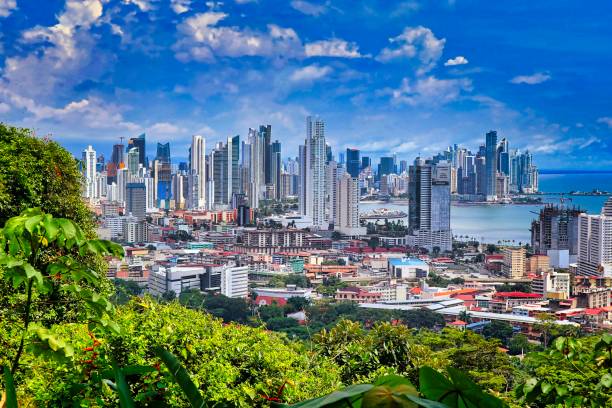
The following is an overview of the fintech ecosystem and its relation to wider economic development of Panama in 2026.
Few countries have built an economy around the movement of goods quite like Panama. Every day, thousands of ships transit the Panama Canal, connecting Asia, Europe and the Americas through one of the world’s most strategic trade corridors. Around this flow of global commerce has grown an economy centred on logistics, banking, shipping and international business.
It is this position-not population size-that has shaped Panama’s fintech sector.
Unlike many Latin American countries where fintech has largely developed to address financial exclusion, Panama’s opportunity lies in making international commerce faster, more transparent and increasingly digital. As trade evolves, so too must the financial infrastructure supporting it.
According to the International Monetary Fund (IMF), Panama’s economy is projected to reach approximately $102billion this year. Gross domestic product (GDP) per capita is around $22,000, making it one of the wealthiest countries in Central America. Logistics, financial services, shipping, construction, tourism and the Panama Canal remain the country’s principal economic pillars. Panama City serves as one of Latin America’s leading financial centres, supported by institutions including Banco General, Banistmo, Global Bank and Caja de Ahorros.
The financial engine behind global trade
Panama’s banking sector was built to serve international business. With more than 50 domestic and international banks operating in the country, Panama has developed one of Latin America’s largest international banking centres. This has created fertile ground for fintech companies specialising in cross-border payments, trade finance, treasury management and compliance technology rather than solely consumer banking.
As global supply chains become increasingly digital, importers, exporters, freight forwarders and logistics providers require financial services that move as efficiently as cargo itself. Digital invoicing, embedded finance, automated foreign exchange and real-time international payments are becoming integral to Panama’s competitiveness as a global logistics hub.
The Superintendency of Banks of Panama continues strengthening regulatory oversight while encouraging financial innovation through greater digitalisation across the banking sector.
Building a cashless economy around commerce

Although Panama has traditionally relied heavily on cash, consumer behaviour is changing rapidly.
Banks have expanded mobile banking, instant payments, digital wallets and contactless payment solutions, while merchants increasingly accept QR-code payments and electronic transfers. The country’s high smartphone penetration and well-developed telecommunications infrastructure have accelerated this transition.
Rather than replacing traditional banks, fintech firms are increasingly partnering with established financial institutions to improve customer experience and modernise payment infrastructure.
The National Bank of Panama (Banco Nacional de Panama) and the wider banking sector continue investing in payment modernisation to support both domestic commerce and international business transactions.
A fintech ecosystem with regional ambitions
Panama’s fintech ecosystem may be smaller than those of Brazil or Mexico, but it occupies an important strategic position.
Companies including Cuanto, KrediYA, Tuloan, PagueloFacil and several digital-payment providers are developing solutions spanning merchant services, SME finance, digital lending and payment processing. At the same time, international fintech firms increasingly view Panama as a gateway to Central America and the wider Caribbean.
The Panama Fintech Association has also helped strengthen collaboration between regulators, financial institutions and technology companies while promoting the country as a regional innovation hub. More information is available at https://fintechpa.org.
Trust matters as much as technology
For Panama, fintech development is closely linked to confidence. The country has spent recent years strengthening transparency, anti-money laundering controls and financial supervision following increased international scrutiny of its financial system. These reforms are not simply regulatory exercises-they are essential for maintaining Panama’s role as an international financial centre.
The Financial Action Task Force (FATF) removed Panama from its increased monitoring list in 2023 following significant improvements to its anti-money laundering and counter-terrorist financing framework. Since then, authorities have continued implementing reforms designed to strengthen regulatory credibility and reinforce investor confidence.
For fintech companies involved in cross-border payments and international financial services, strong compliance has become a competitive advantage rather than simply a legal requirement.
The Panama Canal is digital too
The Panama Canal is often viewed as an engineering achievement, but it is increasingly becoming a digital one.
Shipping companies now depend on sophisticated logistics platforms, electronic documentation and integrated financial systems to move cargo efficiently across global supply chains. As maritime trade becomes increasingly data-driven, fintech is helping facilitate payments, insurance, customs processes and trade finance that accompany the physical movement of goods.
In this sense, Panama’s fintech future is inseparable from its logistics future. Digital finance is becoming another layer of infrastructure supporting one of the world’s most important trading crossroads.
Looking ahead for Panama
Panama’s greatest fintech opportunity is not to become Latin America’s largest start-up ecosystem. It is to become the financial technology platform that supports international commerce across the Americas.
As trade corridors become increasingly digital, compliance standards continue to strengthen and cross-border payments evolve, Panama is well positioned to combine its established strengths in banking and logistics with a new generation of financial technology. For one of Central America’s wealthiest economies, fintech is becoming the invisible infrastructure that keeps global trade moving.
The post The Fintech Landscape of Central America: Panama in 2026 appeared first on The Fintech Times.

