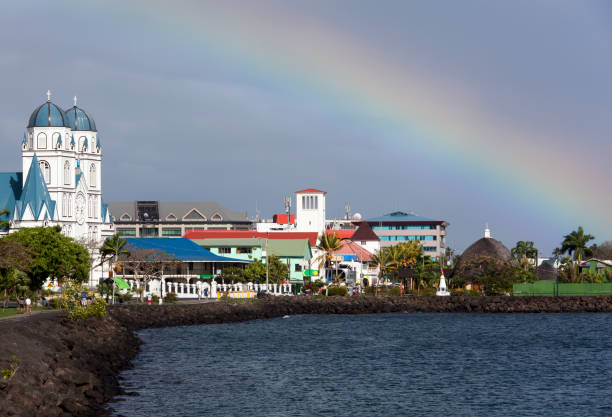
The following is a fintech and wider digital economic development view of Pacific Island nation of Samoa.
In Samoa, the most economically important digital payment may originate thousands of kilometres away.
It might be sent by a nurse in Auckland, a construction worker in Sydney or a family member living in California. Within minutes, that money can help pay an electricity bill, purchase food or cover school expenses in a village on Upolu or Savai’i.
This is why Samoa’s fintech story should not begin with start-ups, cryptocurrencies or digital banks. It begins with the diaspora.
Remittances are deeply embedded in the country’s economic and social life, linking Samoan households with communities across New Zealand, Australia, the United States and elsewhere. Yet receiving money has traditionally involved fees, travel and dependence on cash-based transfer agents.
Digital finance offers Samoa an opportunity to shorten that journey. Mobile wallets, faster interbank transfers and direct-to-wallet remittances can make funds cheaper and easier to receive. The larger challenge is converting those isolated transactions into a financial system that people use regularly rather than only when money arrives from overseas.
A financial market shaped by distance
Samoa is a small Pacific island economy with a population of around 225,000. Tourism, agriculture, fisheries, construction, commerce and public services all contribute to economic activity, while Apia functions as the country’s administrative and financial centre.
The banking system includes ANZ Bank Samoa, BSP Financial Group, the National Bank of Samoa and Samoa Commercial Bank. However, conventional financial services can be difficult to access outside the capital and larger settlements.
Distance matters differently in Samoa than it does in continental economies. Communities are spread across several islands, transport can be costly and maintaining branches or cash infrastructure in less populated areas is commercially difficult.
According to the International Monetary Fund (IMF), Samoa’s economy is expected to continue recovering as tourism strengthens and domestic activity expands, although it remains vulnerable to climate events and external economic shocks. The IMF’s latest country assessment highlights both the country’s improving outlook and the importance of strengthening financial resilience.
Digital finance cannot eliminate those vulnerabilities. It can make the domestic economy more connected and reduce the cost of moving money across it.
Remittances are Samoa’s natural fintech market
Remittances represent far more than a source of foreign currency. They are part of the financial architecture supporting household consumption, education, housing and community obligations.
According to the IMF’s 2025 Financial System Stability Assessment, approximately 80 per cent of Samoa’s inward remittances continue to be transmitted through money transfer operators because they remain the fastest and most accessible channel for many families. The report also highlights the risks posed by declining correspondent banking relationships and the need for resilient digital payment channels.
This makes remittance technology especially important. A cheaper transfer does more than save a customer several dollars. Across thousands of transactions, reduced fees leave more money with Samoan families and within the domestic economy.
Digital channels also allow recipients to receive funds directly into a mobile wallet instead of travelling to an agent, collecting cash and then making another journey to pay bills or deposit money.
The mobile operators became financial providers
Two of Samoa’s most important fintech providers are not banks – they are telecommunications companies.
M-Tala, operated by Vodafone Samoa, enables customers to send and receive money, purchase airtime, pay utility bills and receive international remittances directly into their mobile wallets. The platform integrates with international remittance providers including OrbitRemit, Rocket Remit, Ria and KlickEx, allowing overseas transfers to arrive digitally rather than in cash.
Vodafone has continued expanding the platform through its dedicated M-Tala mobile application, adding features such as QR-code payments, transaction histories and improved wallet management.
A second major provider is MyCash, operated by Digicel Samoa. MyCash offers mobile payments, person-to-person transfers, merchant payments and bill settlement through a smartphone application, while partnerships with international money transfer companies have strengthened its remittance capabilities.
This year, Digicel expanded MyCash’s international reach through a partnership with Ria Money Transfer, enabling overseas remittances to be delivered directly into customers’ mobile wallets.
These services demonstrate that in Samoa, fintech innovation is arriving through mobile networks that already connect communities across the islands.
Registration has not guaranteed regular use

Mobile money’s presence does not necessarily mean Samoa has become a cashless economy.
The Central Bank of Samoa‘s 2022–2023 Annual Report shows that while mobile-money enrolment continued to increase, active usage remained considerably lower than total registrations. The number of active agents also declined, highlighting the challenge of building sustainable digital payment ecosystems rather than simply opening accounts.
This is an important lesson. Opening a digital wallet is relatively straightforward. Creating enough reasons for people to continue using it every day is considerably harder.
Consumers need merchants that accept mobile payments, reliable cash-in and cash-out networks, transparent pricing and confidence that digital money will always be available when they need it.
Recognising these challenges, Samoa’s National Financial Inclusion Strategy II (2022–2026) places strong emphasis on expanding digital financial services, encouraging fintech innovation, strengthening payment infrastructure and improving financial literacy throughout the country.
Building the rails beneath the applications
The most important fintech development in Samoa may not be a consumer application at all. It is the country’s payment infrastructure.
The Samoa Automated Transfer System (SATS) was introduced to modernise domestic payment processing and provide real-time settlement between financial institutions. According to the International Finance Corporation (IFC), the new platform is expected to strengthen financial inclusion, improve payment efficiency and provide the digital foundation upon which future fintech services can be built.
Modern payment infrastructure matters because fintech cannot scale efficiently when transfers between banks, wallets and payment providers remain slow or fragmented.
The Central Bank of Samoa is also beginning to encourage innovation more directly.
In 2026, it admitted PacWallex and the TickTap Card, developed by FreedomPacific Samoa, into its regulatory sandbox to test new financial technologies within a supervised environment. This signals an important evolution in the country’s regulatory approach—from supporting digital finance in principle to actively evaluating innovative products before wider market adoption.
Looking ahead
Samoa does not need dozens of fintech companies to transform its financial system. It needs a smaller number of trusted services that solve the country’s biggest financial challenges: reducing remittance costs, expanding financial access outside Apia, improving interoperability and gradually reducing dependence on cash.
The foundations are already emerging through M-Tala, MyCash, SATS and the Central Bank’s growing support for innovation.
In Samoa, fintech’s success will not be measured by billion-dollar valuations or venture capital investment. It will be measured by how much more of every remittance reaches a family, how easily that money can be spent digitally and whether financial technology can make life simpler for communities spread across one of the Pacific’s most geographically dispersed island nations.
The post Samoa: Fintech Begins With Money Sent Home appeared first on The Fintech Times.