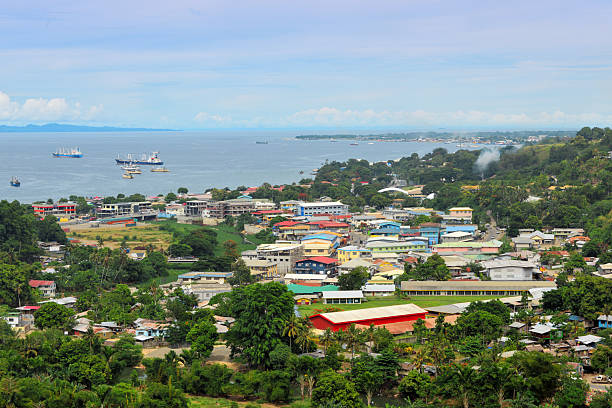
The following is a fintech and wider digital economic development view of the Solomon Islands in 2026.
In the Solomon Islands, getting to a bank can sometimes mean getting into a boat. That simple reality explains more about the country’s fintech opportunity than almost any statistic.
Spread across nearly 1,000 islands in the South Pacific, the Solomon Islands presents financial institutions with an extraordinary logistical challenge. Building bank branches, maintaining ATMs and transporting physical cash between communities is expensive when customers are dispersed across hundreds of islands and vast stretches of ocean.
For many Solomon Islanders, therefore, fintech is not about making an already convenient financial system slightly faster.
It is about accessing one in the first place. Mobile money, real-time payment infrastructure and QR codes are beginning to offer an alternative. A basic mobile telephone can potentially connect someone living far beyond Honiara with financial services that previously required substantial travel. In 2026, that transition is gathering momentum.
An economy where geography matters
The Solomon Islands economy remains heavily dependent on natural resources and public expenditure. Logging has historically been particularly important, alongside fisheries, agriculture, mining, construction and tourism.
Honiara, on Guadalcanal, is the country’s commercial and financial centre. Major financial institutions include Bank South Pacific (BSP), ANZ and Pan Oceanic Bank.
The International Monetary Fund (IMF) expects the economy to grow by approximately 2.6 per cent this year, with nominal gross domestic product (GDP) reaching around $1.88billion.
Longer-term economic challenges remain considerable. The IMF has highlighted declining logging production, infrastructure constraints, vulnerability to climate change and the need to create employment for a young and growing population.
Financial access represents another challenge. Research highlighted by the GSMA found that historically only around one-quarter of Solomon Islanders had bank accounts, while significant parts of the population either relied on informal financial services or remained financially excluded.
This is where mobile technology changes the equation.
The telephone can travel where the branch cannot

The most significant recent development has been M-SELEN. Launched commercially in 2023 by Our Telekom, with support from the UN Capital Development Fund and Australia, M-SELEN became the country’s first licensed mobile-money service.
Customers do not need a conventional bank account. Instead, they can use a mobile telephone to deposit and withdraw money through agents, transfer funds, purchase airtime and pay bills. The service operates through both an application and USSD, meaning customers do not necessarily require a smartphone or mobile internet connection.
That distinction is particularly important in the Solomon Islands. A fintech product designed only for smartphones risks excluding precisely the communities digital finance is supposed to reach.
M-SELEN’s growth has consequently been remarkable. By this year, operator Telekom Digital reported more than 450,000 registered customers, supported by over 5,500 agents and 4,500 merchants nationwide. The company also introduced international remittance services during this year.
For a country with a population well below one million, those numbers demonstrate how quickly mobile money can scale when the underlying problem is genuine financial access rather than simply consumer convenience.
Fintech here looks different
The Solomon Islands is not developing a fintech ecosystem resembling Singapore or Australia. There are few venture-capital-funded neobanks or wealthtech platforms. Instead, financial innovation is emerging from telecommunications companies, banks and specialised payment providers.
M-SELEN is the clearest example, but EziPei also provides a mobile wallet designed to operate across different mobile networks and on both smartphones and basic telephones. Its services include person-to-person transfers, merchant payments, bill payments and remittances.
BSP has similarly expanded mobile banking, allowing customers to transfer funds, check balances and purchase prepaid electricity, water and telephone credit without visiting a branch.
The objective is practical rather than fashionable. If someone living on another island can receive wages digitally, pay an electricity bill and send money to relatives without travelling to Honiara, fintech has already solved a significant economic problem.
Building a payment system beneath the islands
Mobile wallets alone cannot modernise a financial system. The infrastructure connecting banks also has to change.
In April 2024, the Central Bank of Solomon Islands launched the Solomons Automated Transfer System (SOLATS), a real-time gross settlement payment platform developed with technical assistance from the International Finance Corporation and support from Australia, New Zealand and the World Bank. SOLATS allows financial institutions to settle transactions electronically in real time, strengthening the infrastructure beneath the country’s increasingly digital economy.
Consumers may never know the system exists. That does not make it any less important.
Modern fintech applications ultimately depend on reliable infrastructure capable of moving money between institutions securely and quickly. For the Solomon Islands, SOLATS provides part of that foundation.
The next step could be one QR code
In 2026, the country began tackling another familiar problem: fragmentation. The Central Bank of Solomon Islands, working with Australia, launched nationwide consultations on creating a unified national QR-code payment standard.
The objective is interoperability. Rather than merchants potentially needing different QR codes for different payment providers, a common standard could allow customers to pay through participating wallets and financial institutions using the same QR infrastructure.
The central bank specifically sees the initiative as a way to extend electronic payments to underserved and financially excluded communities. For small merchants, the economics are compelling. Printing a QR code costs considerably less than installing and maintaining conventional card terminals, particularly in remote communities. A market stall does not need sophisticated payment hardware if the customer’s telephone can become the payment instrument.
Financial inclusion has been a long-term project
These developments are not occurring in isolation. The Central Bank of Solomon Islands has pursued successive national financial inclusion strategies since 2011.
Its third strategy, covering 2021 to 2025, placed digital financial services among the central mechanisms for extending affordable financial products to underserved communities, particularly women and rural households.
The country was also an early adopter of gender-specific financial inclusion objectives. According to the central bank, the Solomon Islands became the first country globally to incorporate women’s financial inclusion explicitly into a national financial inclusion strategy.
That remains particularly relevant because geographical exclusion can compound other barriers to formal finance. Technology provides an opportunity to remove some of them-but only if services remain affordable and accessible on the devices people actually use.
Looking ahead for the Solomon Islands
The Solomon Islands does not need hundreds of fintech start-ups. It needs technology capable of making distance less important.
M-SELEN has demonstrated that mobile money can reach hundreds of thousands of people. SOLATS is modernising the infrastructure underneath the financial system, while the proposed unified QR standard could make everyday digital payments easier for merchants and consumers.
The country’s fintech transformation will therefore be measured differently from those of larger markets. In the Solomon Islands, success may ultimately mean that opening a bank account, receiving money or paying a bill no longer depends on which island someone happens to live on.
The post Solomon Islands: When the Bank Branch Is an Island Away appeared first on The Fintech Times.