Day two in Miami belonged to BNY, BNP Paribas, Deutsche Bank, Citi and HSBC describing agents that repair payments, triage trades and check documents in production, with people kept for the decisions that matter. Citi went live on Swift’s payments scheme in four markets, and The Fintech Times sat down with HSBC and BNP Paribas.
If Monday in Miami was about the rails, Tuesday was about the work that runs over them. The second day of Sibos belonged to banks describing AI agents that already repair payments, triage trades and check documents in production, and insisting that however much work the agents take on, the decisions stay with people. On the rails themselves, Citi became the first bank to run multi-market instant payments over Swift‘s payments scheme, and Swift said most of its first-mover banks have now used the ledger, across five currencies.
Agents do the work, people keep the judgement
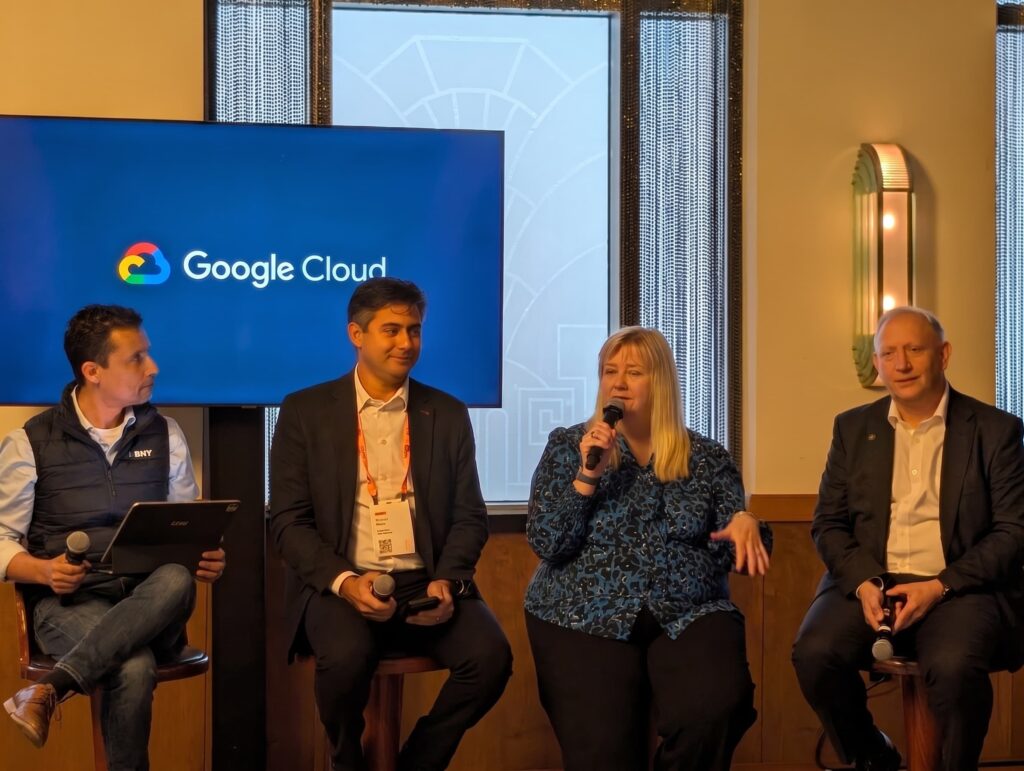
The clearest account of where the large banks have got to came at Google Cloud‘s media roundtable on Tuesday morning, moderated by Georgina Bulkeley, Director of Financial Services Solutions at Google Cloud, where BNY, BNP Paribas, Deutsche Bank and Citi each described a live agentic workflow.
Sarthak Pattanaik, Chief Data and AI Officer at BNY, chose the example most suited to a Swift conference: payment repair. Most instructions go straight through, but a small share still need a person because the beneficiary, the reference data, the address or the purpose of the payment is wrong. BNY has built what it calls a digital employee that reads each of those fields for meaning, checks the syntax against ISO 20022, and then asks whether the payment as a whole makes sense as the movement of value it claims to be. AI does the reasoning, deterministic guardrails do the vetting, and people make the judgement calls. Behind it sits Eliza, the platform BNY has been building since 2023 under a mission of AI for everyone, everywhere and everything, designed to turn staff from consumers of AI into people who solve problems with it.
Charles Holive, Chief AI Officer for Corporate and Institutional Banking at BNP Paribas, which signed a five-year agentic AI partnership with Google Cloud last week, runs AI as a business unit reporting to the chief executive rather than as a cost centre under technology. Instead of a thousand proofs of concept, the bank is running six large transformation programmes under its plan to 2030. His example was trade processing in securities services, cut from ten steps to six with the agent, not a person, now dispatching work from step to step. When an agent was first put at the gate to triage incoming email, it sent almost everything to exceptions, so the team turned each exception from a hand-off into a request for a person to teach the agent. Within a couple of weeks it was handling 80 to 85 per cent of the work, and with staff taken off the mailbox entirely, adoption was total from day one. Every model interaction at the bank runs through an observability layer carrying guardrails set by compliance, legal and HR. Asked about the pace of new model releases, Holive said the models of six months ago are good enough for most of the bank’s transformation, and that the newest carry less visible reasoning, which is a new risk for a regulated firm. “I am not waiting for more models,” he said. “I’m waiting for better harness, better governance, better control.”
Joanne Hannaford, CIO and CPO of Deutsche Bank’s Corporate Bank, said the bank has moved from experimentation to industrial scale on an agentic framework it calls Ada, after Ada Lovelace, which lets agents be reused across the bank. Deutsche was a design partner for the financial research agent in Google Cloud’s Gemini Enterprise for Financial Services, launched in August, which gives its coverage bankers a view of market, macroeconomic and client-specific issues before the client raises them. The data matters as much as the model: using knowledge graphs, its German lending business for smaller companies last week onboarded a new client and issued a loan in a day, a process that would have taken a month.
Stephen Randall, Interim Services COO and Global Head of Liquidity Management Services at Citi, described onboarding documents moving towards agent-to-agent exchange between bank and client, being rolled out in North America, and pointed back to Arc, the enterprise-wide control layer Jane Fraser set out from the plenary stage on Monday. On regulators, he said banks are walking supervisors through their use cases, including where the human sits in, on or out of the loop, because the aim is to go fast but safely.
Google applied the same rule to its own finance function, where, as Vice President of Finance Kristin Reinke put it, an answer that is almost right does not work. Its treasury, handling well over 100,000 transactions a day, now runs agents that forecast surplus cash and pick where to place it, with the decision left to the cash manager.

From exceptions to interfaces
The same thread ran through the day’s launches. Finastra added Repair Recommendations to its OperatorAssist tool, using AI to find payment exceptions, work out the root cause and suggest repairs that respect the rules of Swift, Fedwire, SEPA, UPI and Nexus. HSBC, a day after launching Smart Checking for trade documents, unveiled HSBCnio, which brings its transaction banking into clients’ own channels and lets their AI tools query authorised account data through a Model Context Protocol connection.
Not every bank is at that stage. Bottomline‘s sixth Payments Intelligence Gap study, published on Tuesday, found that more than a third of the 300-plus banking and payments professionals it surveyed have no AI in their payment operations at all, while almost half say integrating it is a critical or high priority for the next 12 months.
Customers are drawing the same line as the banks on the stage. The Banking Expectation Gap, the global research Temenos released with Celent at its stand this week, surveyed more than 2,500 banking customers across five regions and found that 68 per cent would use a conversational AI interface for their banking queries, but fewer than half would definitely let AI take actions for them, with privacy and data security (47 per cent) and the risk of AI errors (36 per cent) the main worries. Three in four are only moderately satisfied or less with their main bank, more than half are dissatisfied with payment services, and a quarter have recently considered switching, while 46 per cent of the banks Celent surveyed plan major core system changes in 2027. The Fintech Times has covered the research in a separate feature.
The rails keep moving
Citi became the first bank to launch multi-market instant payments on the Swift payments scheme, letting clients reach domestic instant rails in Australia, the UK, India and the US through one account structure, without separate local banking relationships. Swift, for its part, says more than 100 institutions are now live or going live on its consumer payments framework and that most of the 17 first-mover banks have now used the ledger for round-the-clock payments in five currencies: euro, sterling, Hong Kong dollar, Singapore dollar and US dollar. The supplier layer that started arriving on Monday kept growing, with Chainlink setting out how banks can connect their existing systems and signing infrastructure to the ledger while keeping their own keys and governance.
The Fintech Times on day two
The Fintech Times sat down with HSBC and BNP Paribas on Tuesday, and both conversations fitted the day.
Tom Elliott, Chief Operating Officer of Global Trade Solutions at HSBC, made the case for trade as the prime ground for AI: around four billion documents move trade every day, only one to two per cent of them digital. Smart Checking breaks the job into modules, from digitising documents to reasoning over the conditions a transaction must meet, built on the ICC’s rules and the tacit knowledge of HSBC’s trade specialists. Like BNY and BNP Paribas, HSBC keeps its experts for the points that matter. “It is an exceptions-based workflow,” he said, with people brought in for edge cases, higher-value transactions and anything the system is not fully confident about. watch the full interview here
Wayne Hughes, who leads the central digital assets team in BNP Paribas’ Securities Services business, said client interest is rising but only a few clients are ready for production. Tokenised money market funds lead, for now as a distribution play with collateral the longer-term prize. He called Swift’s ledger a step in the right direction but not the finish line, expects central bank money, tokenised deposits and stablecoins all to have a place, and sees perhaps a dozen blockchains surviving rather than hundreds. The next hurdle is cross-border: which rules apply when a client in Asia-Pacific buys a tokenised asset in Europe. That, he said, is where a neutral player everyone is connected to, such as Swift, still has a job to do. watch the full interview here
Around the floor
The organiser says more than 10,000 participants have gathered in Miami. Wednesday brings The Clearing House‘s Dave Watson to View from the Top, and The Fintech Times on camera with Temenos, HSBC‘s Melissa Tuozzolo and Standard Chartered‘s Rene Michau.
The post Sibos 2026 day two: banks put AI agents to work, but keep the judgement for people appeared first on The Fintech Times.