
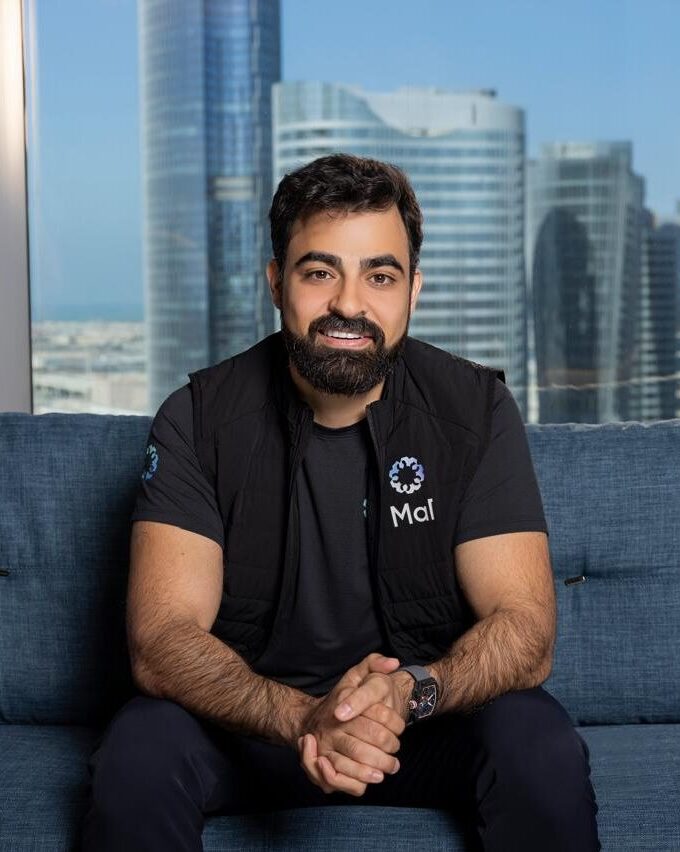
Mal, an Abu Dhabi-based fintech founded in 2025 by Emirati entrepreneur Abdallah Abu-Sheikh, has disclosed a US$230 million seed round that it describes as the largest publicly announced fintech seed investment in the Middle East and Africa. The company has also received in-principle approval from the Central Bank of the UAE to establish a licensed bank, a milestone that moves it from a technology proposition to a regulated financial institution.

The release does not name the investors who committed to the seed round, nor does it disclose the lead backer, a material gap for a funding figure of this size. The company’s valuation was also not disclosed.
What Mal is building
The platform is designed around the premise that AI should be embedded in core banking architecture from inception rather than layered onto existing systems. Abu-Sheikh is positioning this as structurally different from the first wave of digital banks, which largely replicated traditional current-account and lending products through mobile interfaces without rearchitecting the underlying logic of the services.
Mal’s stated product scope is broad: global accounts for freelancers and cross-border earners, AI-driven personal finance tools, lifestyle financing across shopping, travel and education, and business solutions for SMEs. The unifying design principle is that an AI layer connects these products, infers customer needs across interactions and surfaces relevant services without requiring the customer to navigate between separate product silos.
The Islamic finance component is framed not as a product-level compliance exercise but as a design philosophy. Abu-Sheikh said Islamic financial principles inform how products are structured, how risk is assessed and how customers are treated, rather than simply determining which contracts are permissible. He added that the platform intends to assess emerging categories such as digital assets against Islamic financial criteria on a case-by-case basis, rather than blanket acceptance or rejection.
“AI should not sit on top of banking; it should change how banking works,” said Abu-Sheikh. “When AI is built into the foundation, it can understand what customers need, connect what used to be fragmented, and turn processes that took days or weeks into minutes or seconds.”
Market context and regulatory path
The UAE is a credible launchpad for this proposition. The country ranks third in the Islamic Finance Development Indicator 2025, with Islamic financial assets across 43 licensed institutions reaching AED 1.4 trillion, a figure targeted to rise to AED 2.56 trillion by 2031. The regulatory environment, spanning the Central Bank of the UAE, ADGM and DFSA, has demonstrated openness to issuing new banking licences to well-capitalised fintech applicants, and Abu Dhabi has actively positioned itself as a hub for AI-first financial services infrastructure.
The competitive landscape for digital Islamic banking is thinner than for conventional neobanking but developing quickly. Regional players and several Gulf-backed challengers are pursuing similar positioning at the intersection of sharia-compliant finance and mobile-first distribution. The global Islamic finance market, estimated to encompass roughly two billion potential customers, remains largely underserved by technology-native propositions, which is the structural gap Mal is betting on.
The critical near-term milestones are the conversion of in-principle approval into a full banking licence, the public disclosure of investors and governance structure, and evidence of customer traction once the platform opens to users. Abu-Sheikh previously founded Astra Tech and Botim, giving him operational experience scaling technology platforms in the region, though building a regulated bank carries compliance and capital requirements of a different order. Observers will watch whether the $230 million seed is sufficient to absorb both product build and the regulatory capital requirements a UAE banking licence demands.
The post Mal Raises $230m Seed to Build AI-Native Islamic Bank from Abu Dhabi appeared first on The Fintech Times.

