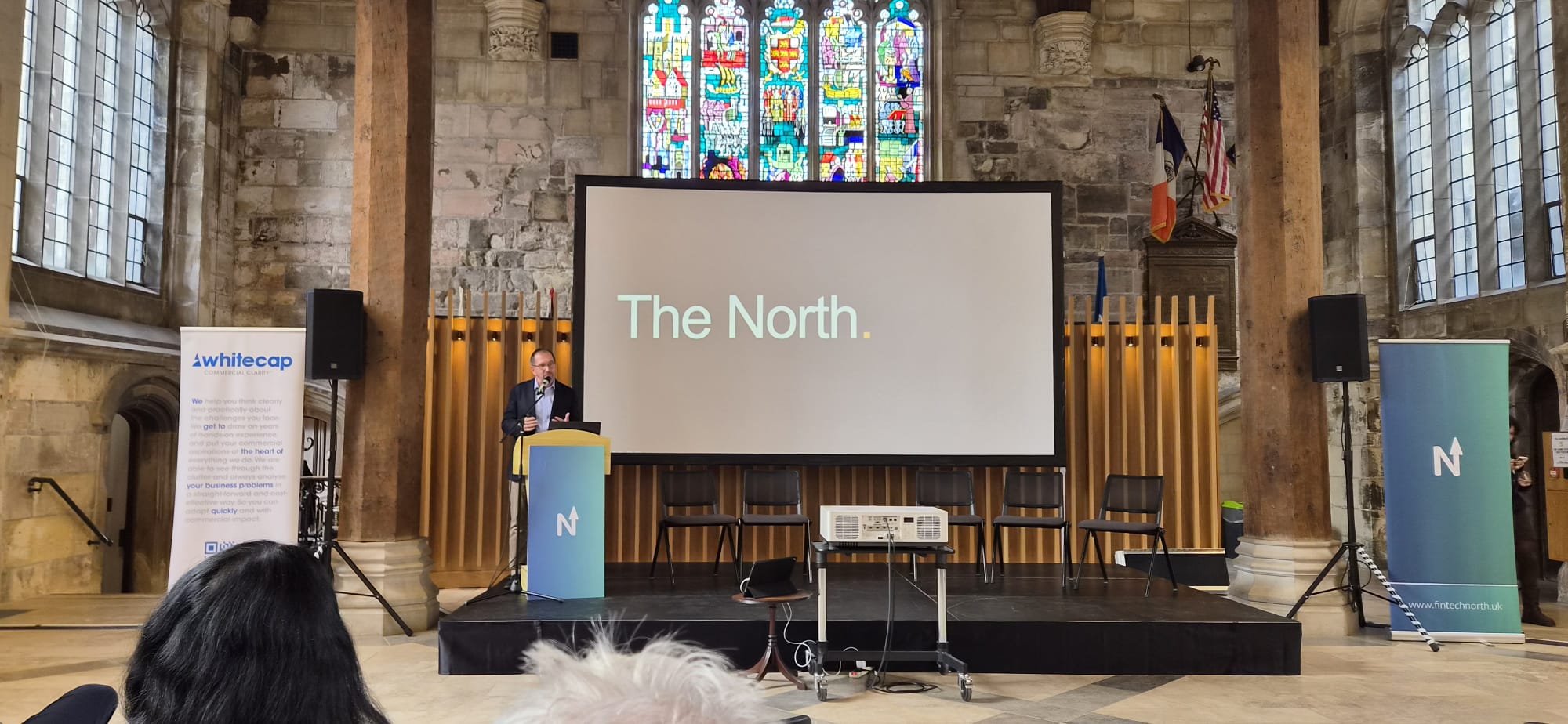
From AI agents making financial decisions to geopolitical threats, financial inclusion and the future of work, day one of FinTech North‘s Northern FinTech Summit 2026 in York showed just how many of the sector’s challenges come down to ‘trust’.
York’s Guildhall has seen plenty over the centuries. Built in 1445, it has hosted council meetings and criminal trials, and is thought to be where a £200,000 ransom for King Charles I was counted out.
On Wednesday, money was still on the agenda as FinTech North returned to the city for the first day of its Northern FinTech Summit 2026. This time, the discussion included whether AI agents could end up triggering bank runs while we’re asleep.
The possibility was raised by Colin Payne, head of innovation at the Financial Conduct Authority (FCA), during the opening Chris Sier Keynote, delivered in memory of FinTech North’s former chairman.
Payne warned that a ‘swarm of agents’ all making financial decisions at once could cause serious problems, especially when they’re acting faster than any human can keep track of. AI agents can already pay bills, negotiate with suppliers and manage everyday tasks on our behalf.
He described what he called a ‘trust inversion’ – we’ve got the technology, but how many of us are ready to let an AI agent loose on our bank accounts?
“The technology is here now. It’s arriving before consumers have got trust in it,” he warned.
Payne brought up George Hudson, York’s ‘Railway King’, who helped put the city on the railway map before things went rather badly wrong. In 1849, it turned out Hudson had been paying dividends using investors’ capital rather than profits. Not quite what the people putting their money into the railways had signed up for.
Payne reckons there’s a lesson in that for AI. The railways were booming before anyone had got a proper grip on how they were being run. Now we’ve got AI agents that can manage our money and make decisions for us, while regulators and businesses are still working out who takes responsibility when something goes wrong, or how anyone is supposed to keep track of it all.
That doesn’t mean Payne wants to put the brakes on AI. “Doing nothing is a risk as well,” he said, suggesting that the North’s fintech community has an opportunity to help drive what comes next and make sure people can trust it.

Trust under pressure
Trust was turning into something of a word of the day at the Guildhall, although it meant different things to different speakers.
For Ben Wilson, vice president of government affairs and policy at Mastercard, it was about keeping financial systems secure at a time when geopolitical tensions were creating more risks for businesses.
“Trust is the most valuable asset here,” he said, warning that even fintechs handling billions of pounds in transactions could lose customers if they lost confidence in their security.
With cyberattacks increasingly linked to geopolitical tensions, Wilson argued that protecting that trust had become a business priority, rather than simply something for the IT department to worry about.
Trust starts with understanding your customers
For Hannah Morrison, founder of Clear Creator, a consultancy that helps financial services businesses put Consumer Duty requirements into practice, trust was more about whether financial products actually work for the people using them.
Speaking about the FCA’s Consumer Duty, she shared her experience of helping her brother become more independent. He’d made huge progress, including getting himself to work on the Tube every day, but managing his finances and benefits was still proving difficult.
“One of the main things he struggles with still is digital products and understanding his finances,” she said.
Morrison said financial products often assume people understand the terminology or know their way around an app, when that isn’t always the case. Even something as basic as terms and conditions can be difficult to understand.
“How do you make those terms and conditions understandable, especially for people who might not necessarily have that background knowledge?” she asked.
For Morrison, getting Consumer Duty right means understanding customers properly, including those with additional needs, and checking whether they’re actually getting a good service. She argued that businesses benefit too, with happier customers, less rework and fewer problems further down the line.
“They trust you again,” she said, before adding with a nod to the day’s discussions: “We’re coming back to this theme of trust.”
Can we trust ourselves to think?
With AI doing more of the work, there was also plenty of discussion about what happens to the people using it.
During a panel on fintech talent and skills, Dr Ashleigh McLellan, co-founder of leadership consultancy Anumi, joined Macs Dickinson, director of engineering at LHV Bank, and Crispin Read, CEO of The Coders Guild, to talk about how AI is changing the skills employers need.
Dickinson said LHV Bank had already changed the way it interviews engineers. Candidates can use AI during assessments, but they’re expected to explain their decisions, talk through the trade-offs and show they understand what they’ve produced.
“Not using AI as a substitute for your own intelligence,” he said, was particularly important, warning that people risk losing skills if they rely too heavily on the technology.
McLellan, who has a background in clinical psychology, brought the discussion back to human curiosity and judgement. She questioned whether people were becoming too willing to accept the answers AI gives them, rather than stopping to consider whether they’re right.
Read made a similar point about education, suggesting that schools often teach children to memorise answers rather than encouraging them to experiment, ask questions and learn from mistakes.
And there was another issue: whether people feel comfortable asking questions at work in the first place.
Dickinson talked about trying to create a ‘psychologically safe environment’ for his engineering teams, where nobody was afraid of looking foolish for asking something.
“Is the enemy of curiosity fear?” he pondered.
It brought the discussion back to trust, this time between employers and their staff. As moderator Rhys Griffiths, relationship manager at FinTech Wales, put it: “You build that trust. You build that curiosity.”

A decade of FinTech North
FinTech North is celebrating its 10th anniversary this year, having started with an event in Leeds back in 2016.
General manager Joe Roche told delegates that the North is now home to around 400 fintech businesses, generating approximately £5billion in annual gross value added. Payments businesses account for roughly half of them, although banking, lending, wealthtech and insurtech are also well represented across the region.
The North’s different cities have their own specialisms, and Roche said the aim was for them to collaborate rather than compete.
Indeed, Chelsea Boothroyd from the University of Leeds talked about the Leeds Financial Innovation Exchange, which is bringing financial services organisations, startups and academics together to tackle specific business problems. That includes helping new technology providers find customers, test their products and deal with the sometimes lengthy process of getting their solutions into large financial institutions.
Then Steve Kevan, CEO and co-founder of FinPact, introduced the Edge AI Skills Programme, developed with Newcastle College Group and MediaWorks, with a pilot involving 25 learners already underway.
The programme covers everything from basic AI literacy to more advanced skills, with a focus on using the technology safely and being able to demonstrate that people know what they’re doing.
Kevan mentioned hearing about one large organisation where 40 people were apparently building the same AI agent, each unaware that others were doing the same thing.
AI was already bringing productivity gains to businesses, he said, but there was still that word again: trust.
“Are we using it properly? Are we using it properly within the organisation or as individuals?” he asked.
The post Northern FinTech Summit 2026: Trust Takes Centre Stage as Sector Tackles AI, Risk and Growth appeared first on The Fintech Times.