
Dubai Future Finance Week opened with DIFC growing its academy tenfold, J.P. Morgan opening a private bank branch in the centre and the UAE central bank setting out how dirham stablecoins and a digital dirham will sit side by side. On stage, the argument of the day was corridors.
Dubai Future Finance Week opened on Monday at Madinat Jumeirah, with the Dubai Fintech Summit as its anchor. The first edition of the week has already outgrown its plans: more than 100 events, 12 signature forums and 14 stages across the city, and over 1,000 speakers under the theme Finance Reimagined.
A bigger bet on people
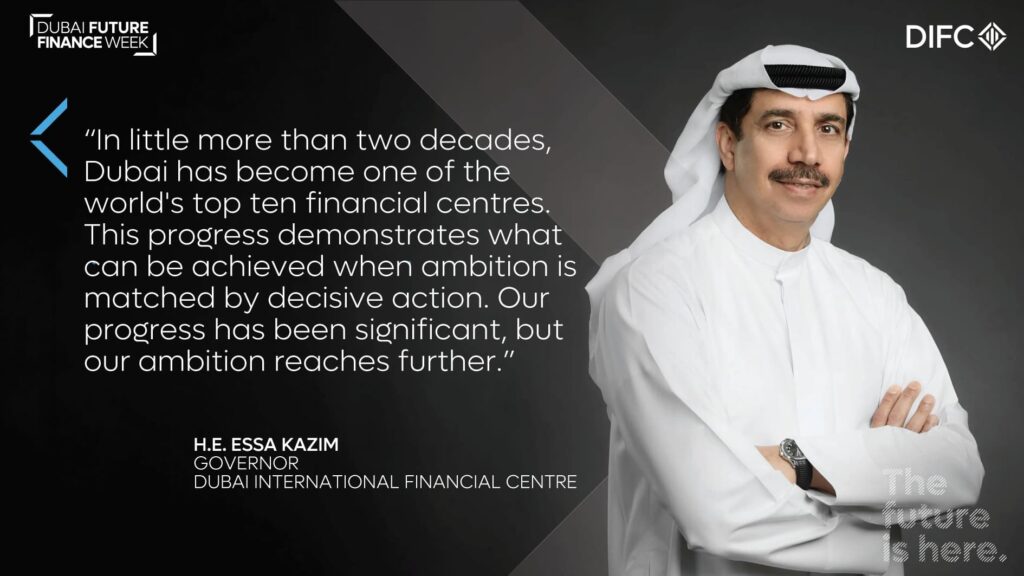
His Excellency Essa Kazim, Governor of DIFC, opened the summit by setting Dubai’s rise against what it still wants. “In little more than two decades, Dubai has become a top 10 financial centre, showing what ambition and decisive action can achieve,” he said.

The numbers he brought were about momentum. DIFC recorded more than 2,200 new active companies in the first nine months of 2026, an all-time high and 26 per cent more than a year earlier, and its AI, fintech and innovation community grew by close to 500 firms net over the past 12 months. AI, tokenisation and digital infrastructure, he argued, are not simply improving existing processes but changing the economics of financial services.
The announcement that went with it was about talent rather than towers. DIFC Academy will grow tenfold to 370,000 sq ft in the new Zabeel District, moving from three floors to a campus of three buildings with 54 seminar rooms, five research spaces and its own graduation hall. From 2030 it will be able to take more than 50,000 learners a year, against 51,620 graduates across its first two decades. His Excellency Arif Amiri, chief executive of DIFC Authority, called it an investment in the people who will shape the next generation of finance from Dubai.
The backdrop is a ranking DIFC will be quoting all week. In September’s Global Financial Centres Index, industry professionals put Dubai first in the world for fintech.
The corridor case, made by a Singapore bank
Corridors ran through the plenary programme, from a chief executives’ panel with Mambu, Network International, SC Ventures and Van Lanschot Kempen to a line-up of ministers. India’s Finance Minister Nirmala Sitharaman was among the day’s government speakers, alongside His Excellency Abdulla bin Touq Al Marri, the UAE’s Minister of Economy and Tourism, and His Excellency Mohamed Hassan Alsuwaidi, Minister of Investment.
The clearest statement of the case came from Jason Moo, chief executive of Bank of Singapore. As the world splits between the US and China, clients want neutral ground for their money, and Singapore and Dubai are becoming the safe harbours they choose. He does not see the two cities as rivals. Bank of Singapore runs its business from three hubs, Singapore, Hong Kong and Dubai, and he sees capital moving both ways between them. The bank has taken Chinese investors and senior managers of Chinese financial institutions to Dubai on two or three trips as they look to diversify, while Gulf clients are moving assets to Asia for safekeeping and looking to ASEAN for growth.
“I’m fully convinced around the Asian and the Middle Eastern corridor because I really feel like that’s where the next alliances will be built,” he said.
Moo also gave the day one of its more practical AI numbers. Bank of Singapore’s own AI agents now carry out KYC work, cutting account opening from around six weeks to 15 days. His warning was about what clients build for themselves. A family office that pulls bank data into a home-made dashboard without serious cyber security becomes the weakest link in the chain, which is why the bank is looking at giving clients a sandbox inside its own firewalls.
Private wealth keeps arriving
Wealth was the day’s other strand. J.P. Morgan Private Bank has opened a new branch in DIFC, regulated by the DFSA, giving it a dedicated platform to serve clients across the UAE and the wider region. The firm has used DIFC as its regional base for corporate and investment banking for 20 years, and more than tripled its Dubai private banking team over the past 12 months to be ready. Selim Elgen, UAE market head, and Karim Rekik, regional head for the Middle East, lead the team.
Two forms of digital dirham
On the second plenary stage, Paul Kayrouz, Chief Fintech Officer at the Central Bank of the UAE, explained how the country’s digital money is meant to fit together. The UAE issued a comprehensive, risk-based stablecoin regulation in 2024, and four banks are now licensed to issue dirham stablecoins, each with its own use case, from retail payments to cross-border flows, corporate treasury and intercompany settlement.
He does not expect those stablecoins to compete with the central bank’s digital dirham. The CBDC is sovereign money, issued and backed by the central bank, and is the natural rail for settlement between banks across borders, while bank-issued stablecoins go after retail, treasury and intercompany uses. The central bank wants to offer the options and let the market, not the regulator, decide which rail wins for which payment. Both serve a larger aim: taking the dirham beyond the UAE’s borders, with the central bank working to bring trading partners in Asia, Africa, the CIS and the wider Middle East onto its rails.
Kayrouz pointed to platforms already running under the central bank’s transformation programme, including an eKYC service that cuts opening a bank account from around 60 days to under a day, an instant payments platform and open finance. On agentic AI, he said the question is when, not whether. The central bank is deploying its own AI agents to watch how agents behave in the market, and he argued that agentic payments will only scale with a human on the loop rather than in it, backed by clear consumer mandates and a quick way to reverse a transaction.
The DFSA brought its own AI work to the summit. With Cambridge’s Digital Innovation and Regulation Initiative, it published a paper on how deployed and agentic AI changes cyber resilience, built around four questions: how fast a firm can close off serious exposure, how far its reliance on shared technology reaches, whether an AI system’s actions stay within its mandate, and whether the firm can establish what happened and restore critical operations. The regulator is clear that it is a contribution to research and international discussion, not guidance. DFSA chief executive Mark Steward and Bryan Zhang of the Cambridge initiative were due to discuss it at the summit.
The view from the merchant
Not everyone on the floor is in a hurry. Harry Gill, chairman of Pay10, which is now live in the UAE, Bahrain and Morocco and added a European licence this year, told The Fintech Times that stablecoin acceptance is on the roadmap for Pay10’s QR code payments, but only once regulation allows it. He doubts consumers will reach for it soon.
“If you already have a dirham account, for you to convert that into a stablecoin then make a payment to buy a coffee, I don’t see that happen right now,” he said. For Pay10, the priority is small merchants: instant settlement and lower costs first, with everything else built on top.
Small businesses were also the focus for Emirates NBD, which on Monday relaunched its National Digital Talent Incubator as NDTI AI, a programme to help established Emirati-owned SMEs among its customers put AI to work. DIFC Innovation Hub will support the programme’s design, with AWS and Visa as partners. Each cohort will take four or five businesses, with two cohorts a year, and use cases will be worked out with each business rather than picked from a fixed menu.
The post Dubai FinTech Summit day one: corridors, stablecoins and a tenfold bet on talent appeared first on The Fintech Times.

