
The DFSA published its view of how tokenised markets can scale and DIFC Courts proposed a way to enforce rulings on chain. On stage at the Future Tokenisation Forum, regulators and market builders agreed that issuing tokens is now the easy part. Making them tradeable is not.
On Thursday, Dubai Future Finance Week turned to two longer-term questions: how family wealth passes between generations, and how tokenised assets can move from pilots into real markets. The Future Tokenisation Forum at Jumeirah Mina Al Salam took the second question, and it was the busiest regulatory day of the week.
A paper that maps the debate
Mark Steward, chief executive of the DFSA, opened the forum with the regulator’s new report, Scaling Tokenisation: The Road Ahead. It draws on input from BlackRock, Ripple, Robinhood, Soter Insure and Standard Chartered, and looks at what tokenisation needs as it moves from experiments into live financial products, payments and market infrastructure. The paper deliberately stops short of picking a winner. It sets out where the industry agrees and where it does not, and does not prescribe a particular technology, rulebook or business model. The DFSA wants it to start a wider conversation with firms, investors, policymakers and international standard setters.
DIFC Courts brought a more concrete proposal. Working with DECA4 Advisory and industry partners, the courts published a white paper on a Dispute Resolution Oracle, an opt-in link between a smart contract and a court or other forum the parties choose before they transact. The gap it targets is simple to state: a court can decide who owns a digital asset, but it cannot make that decision take effect on chain. Under the proposal, a disputed asset would be preserved once a claim is raised and the final decision enforced directly on chain. Judges, arbitrators and mediators would still decide cases off chain, with limited asset freezes, early review, reasoned decisions and rights of appeal as safeguards. The courts are pitching it as an open standard for any jurisdiction, not a Dubai-only tool. Amna Al Owais, deputy director of DIFC Courts, was among the day’s speakers.
Regulators: the wrapper changes, the rules should not
The regulators’ panel was the clearest guide to where supervisors stand. Michail Fekkas, first vice chairman of Greece’s Hellenic Capital Market Commission, argued that tokenisation changes how an instrument is issued, transferred and traded, not what it is. Europe already has the tools in MiFID, CSDR, the DLT Pilot Regime and MiCA, he said, and should not build a separate regime for tokenised assets. The principle should stay simple: same activity, same risk, same regulatory outcome. For him, the real obstacles are now legal uncertainty, fragmentation and whether market infrastructure can pay its way. “Europe must move from regulatory experimentation to regulatory scalability, and smaller European markets must be part of that,” he said.
William Mason, director general of the Guernsey Financial Services Commission, described a lighter-touch route. Guernsey audited its existing laws, found them largely fit for purpose and issued guidance on how it would read them, rather than rewriting them. He added that the GFSC aims to finalise its stablecoin rules next month. His bigger worry was liquidity. Supervisors do not want private assets moved on chain and sold to retail investors who then cannot get out, he said, and he doubted that automated market makers alone would solve it. Real market makers taking positions would be needed for the market to scale. “Buying is easy; anybody can buy,” he said. The hard part is being able to sell.
Paul Kayrouz, Chief Fintech Officer at the Central Bank of the UAE, gave the UAE’s position. The central bank regulates entities, he said, so a bank that starts tokenising securities needs a separate licence from the Capital Market Authority, but the central bank still oversees its whole balance sheet, operational resilience and conduct. On tokenised money, he said the UAE expects central bank digital currency, tokenised deposits and stablecoins to coexist rather than compete. The central bank’s job is to build the rails and let the market choose. The digital dirham is close to launch, the UAE has licensed four banks and one non-bank to issue stablecoins, and several banks are close to launching tokenised deposit programmes. To move beyond closed loops, he said, tokenised assets will need a unified ledger for clearing and settlement, and on-chain records with the same legal force as the assets they represent.
Kayrouz also pointed to a cross-border problem. A handful of stablecoin issuers dominate the market, and their tokens are used in the UAE although they are issued and licensed elsewhere. Protecting consumers then depends on regulators sharing information and working together, he said, because “we will never be in any stage where we will have the same regulation”. An Israeli regulator on the panel made a related point: owning a token used to be a technical question about who holds the key, but scaling it into finance needs a legal answer about enforceable rights, including across borders.
The market view: cheap to imagine, costly to issue
A second panel looked at why tokenisation has barely left the pilot stage. The founder of a UAE-based tokenisation platform said technology is no longer the bottleneck. Cost is: legal advice, issuing vehicles, licences and prospectuses mean the economics rarely work unless an issue runs into hundreds of millions of dollars. Today the money goes to lawyers, administrators and technology vendors, he said, and will shift towards distribution and trading as tokens trade across many venues. He expects funds and traditional capital markets to grow fastest, and warned that tokenising an asset with no clear use will fail. He also called the UAE lucky to have regulators that are approachable and willing to find ways to meet their objectives without blocking new products.
A speaker from the UAE’s Capital Market Authority, which replaced the SCA as a legal continuation on 1 January, said the authority’s tokenisation framework is still narrow, covering only securities and commodities. The CMA is considering a discussion paper to review it in light of market demand. Questions include which assets should qualify, how disclosure should work, who can custody tokens, and whether making illiquid assets easier to buy should change who they can be sold to. There is no single change that would unlock the market, she said.
Distribution: trust before scale
The forum’s closing panel, moderated by BCG, set the scale of the challenge: roughly USD 3trn in crypto assets and about USD 300bn in stablecoins, against only USD 30bn to 40bn in tokenised real-world assets. A partner at SC Ventures, Standard Chartered’s venture arm, said demand today comes mainly from crypto money looking for exposure to traditional assets. Institutions are next, once settlement and collateral benefits make the economics work, and everyone else will follow. Liquidity is the gap. “Just tokenising something doesn’t automatically make it liquid,” he said, adding that more market makers, leverage and links between traditional and digital rails would be needed.
Paul Boots, senior director and head of sector development at VARA, said the authority learns through regulatory pilots, including its expanding real estate tokenisation pilot with Dubai Land Department. Issuance rules are clear and licensed broker dealers can already distribute tokens. The next step is for tokens to trade on more than one platform with market makers behind them, so retail buyers of property tokens can sell when they need to. He was firm when an audience member asked VARA to make licensing easier: liquidity matters, but not at the expense of KYC and anti-money laundering checks. Investors, he said, will end up buying on “the platforms of trust”.
Mohamed Damak, managing director and global head of Islamic finance at S&P Global Ratings, said S&P has rated some tokenised money market funds and digital bonds at the same level as their conventional equivalents after finding that the technology added no extra risk. He named three barriers to scale: the legal structure of what a token holder owns, interoperability between bank platforms and public blockchains, and the money leg, where settlement still waits for banks to open. He pointed to the DIFC Courts proposal as the kind of recourse investors will want before they commit. The president of Robinhood MENA, which arrived in the UAE recently, said investor education remains the biggest hurdle for retail demand.
Family wealth and the next generation
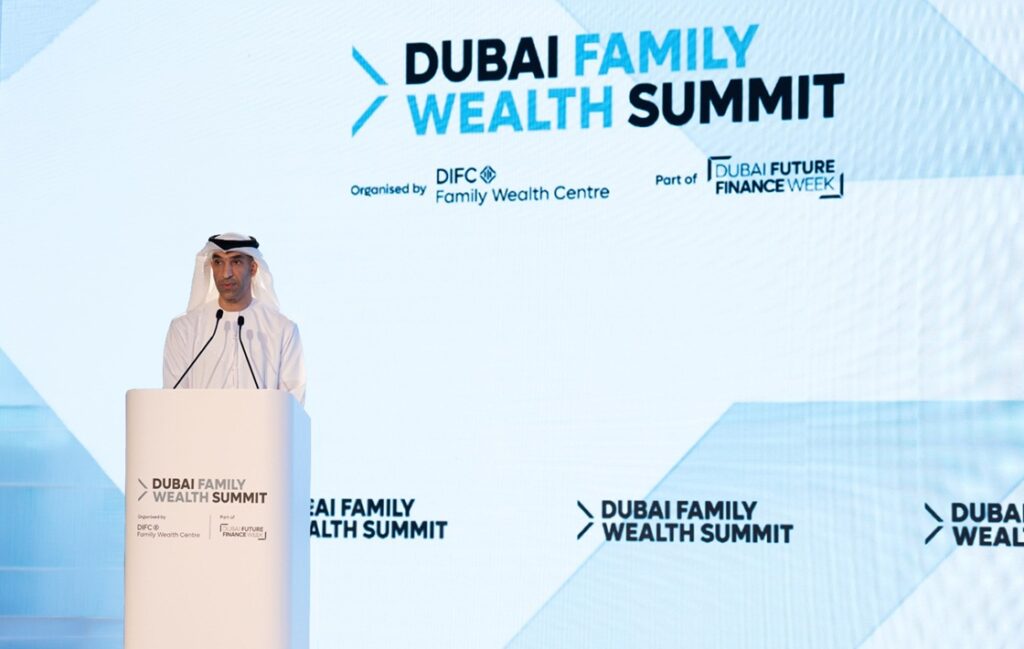
The Dubai Family Wealth Summit, held the same day, focused on governance, succession, structuring and philanthropy, with the UAE’s Year of Family as the backdrop. Dr Thani bin Ahmed Al Zeyoudi, Minister of Foreign Trade, gave the keynote on international connectivity. Speakers included Hussain Sajwani of DAMAC, Halima Dangote of Dangote Industries, Maurice Gravier of Emirates NBD, Shehab Gargash of Gargash Prime and Osama Ibrahim Seddiqi of Seddiqi Holding. DIFC announced a 2027 NextGen Internship Programme that will place future family business leaders in DIFC firms across financial services, audit, consultancy, law and AI, Fintech and innovation, ahead of an estimated USD 18.3trn global wealth transfer by 2030. The Investment Leaders Exchange brought sovereign wealth funds, institutional allocators and family offices together on asset allocation and the place of digital assets in long-term portfolios.

A China to Gulf payments link
Outside the forums, Lianlian DigiTech, the Hong Kong-listed payments group, opened its Middle East regional office in DIFC. The company already holds a DFSA Category 3D payment services licence and will offer cross-border collections, foreign exchange and vendor payouts for businesses trading between China, the Gulf and global markets. It already supports sellers on Noon, Amazon UAE and Amazon Saudi Arabia.
Dubai Future Finance Week closes on Friday with GEFI’s ethical finance conference at DIFC.
The post Dubai Future Finance Week day four: a tokenisation rulebook, a court on chain and the liquidity question appeared first on The Fintech Times.
