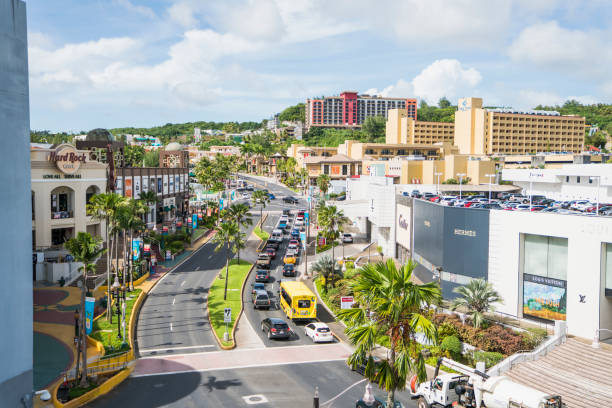
The following is a fintech and wider digital economic development view of the US Pacific territory of Guam.
Guam is part of the American financial system, but geographically it feels anything but American.
The US territory lies in the western Pacific, closer to Manila and Tokyo than Los Angeles or New York. It uses the US dollar, operates within the American regulatory framework and has access to American financial institutions. Yet distance still matters.
For businesses importing goods, families sending money across the Pacific and consumers trying to access financial products designed primarily for the continental United States, being American does not always mean receiving exactly the same financial experience.
This makes Guam an unusual fintech market. It does not need mobile money to compensate for the near absence of banks, as happens elsewhere in the Pacific. Instead, its opportunity lies in using digital finance to overcome the disadvantages of being a small, remote economy while taking advantage of something its neighbours do not possess: direct access to the world’s largest financial market.
Three sources of money drive the island
Guam’s economy has traditionally revolved around three major sources of external income: tourism, US federal expenditure and construction investment.
Tourism remains important, particularly visitors from Japan and South Korea, although the sector has yet to completely return to its pre-pandemic position. The other major story is defence.
Guam’s 2026 economic outlook expects continued expansion supported by tourism recovery, construction and growing numbers of US Department of Defense personnel. Major projects include Camp Blaz, missile-defence infrastructure and wider public and private construction.
That creates an unusual economic environment. Guam is a small island economy, but enormous amounts of American federal and military spending can flow through it. Fintech can help ensure more of that activity translates into efficient financial services for local businesses and residents.
The People’s Bank became a Pacific institution

The obvious place to begin Guam’s financial story is Bank of Guam.
Founded in 1972, the locally headquartered institution has expanded beyond the island into other parts of Micronesia and the wider Pacific. Its importance goes beyond conventional banking.
Bank of Guam increasingly provides the types of services associated with fintech platforms, including mobile deposits, person-to-person transfers, bill payments, personal financial management and digital credit information. It has also introduced Cara, its digital banking assistant
This highlights something important about fintech in Guam. The island is unlikely to produce hundreds of venture-backed financial start-ups. Its population is simply too small. Instead, much of its fintech transformation can happen inside established financial institutions.
Guam lives inside the US payments universe-mostly
Guam’s political status provides an enormous advantage. Residents use dollars and can access American payment networks, credit cards and financial institutions. Federal financial regulation also extends to the territory.
That separates Guam from many neighbouring Pacific island states, where correspondent banking relationships and access to international currencies can represent serious challenges.
Yet Guam’s remoteness can create quirks. Financial applications designed around the 50 states do not always treat US territories consistently. Address verification, card compatibility and access to particular digital products can occasionally create additional friction for territorial residents.
That makes locally embedded financial infrastructure particularly valuable. The fintech opportunity is therefore not necessarily replacing American platforms. It is filling the gaps between a continental financial system and the realities of living on an island nearly 6,000 miles from California.
Broadband may be Guam’s biggest fintech investment
One of Guam’s most consequential digital-finance developments is not actually a financial project. It is broadband.
The territory is undertaking a substantial expansion through the US Broadband Equity, Access and Deployment (BEAD) programme.
Guam’s broadband programme reports approximately $156million of investment, more than 200 miles of underground fibre deployment and plans covering 175 community anchor institutions such as schools, libraries and health centres. It also identifies 1,367 unserved or underserved locations being connected.
The government announced the major deployment phase in November 2025, including resilient fibre connections for almost 1,400 homes and gigabit connectivity for community institutions.
This year, the government has also been procuring cybersecurity monitoring and operational safeguards for BEAD-funded infrastructure.
This matters enormously for fintech. Digital banking cannot become universal if connectivity is unreliable or unaffordable.
Typhoons make resilience more than a technology buzzword
Guam also understands the vulnerability of infrastructure.
Typhoon Mawar struck the island in 2023, damaging homes, businesses, electricity infrastructure and telecommunications. That experience provides a different perspective on the transition towards cashless finance.
Digital payments can make an island economy more efficient, but dependence on them creates another question: what happens when electricity or telecommunications disappear? This is particularly relevant for Guam because natural disasters are a recurring risk.
Financial institutions therefore need to think about digital resilience alongside digital adoption. A payment application is useful when the network works. A resilient financial system must also have an answer for when it does not.
Military investment could create another digital opportunity
The continuing US military build-up could accelerate fintech indirectly. Large construction projects create contractors and subcontractors requiring payroll, invoicing, accounting, payments and working capital.
Small local businesses serving military personnel and their families similarly need efficient merchant-payment infrastructure. This creates opportunities for digital financial services focused less on consumers and more on small and medium enterprises (SMEs).
Guam’s fintech market may consequently develop through business banking, payment processing, accounting automation and embedded finance rather than through another consumer neobank. The territory’s strategic importance can therefore become an economic advantage-provided local companies can participate in the activity surrounding it.
Looking ahead
Guam will probably never become a fintech hub in the conventional sense.
It does not need to. Its opportunity comes from its unusual position: a small Pacific island operating inside the American financial system at a time when billions of dollars of infrastructure and defence investment are reshaping its economy.
Better broadband, increasingly digital banks and access to US payment infrastructure provide strong foundations.
The real challenge is making geography matter less. For Guam, fintech succeeds when being nearly 6,000 miles from the US mainland no longer determines how easily a resident or local business can participate in the American digital economy.
The post Guam: American Finance, Thousands of Miles From America appeared first on The Fintech Times.