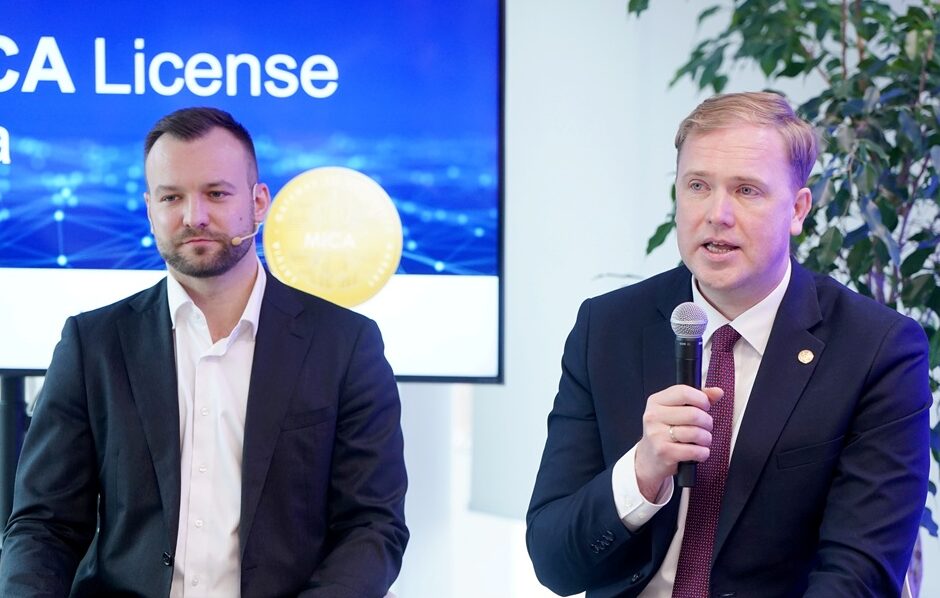
While several European Union member states have yet to issue a single MiCA (Markets in Crypto-Assets) licence, Latvia has quietly transformed into one of the leading Web3 hubs in Northern Europe.
Reinis Znotiņš and Viktors Valainis argue that public-private cooperation has made Latvia a leading MiCA licensing hub, ahead of far larger EU economies.

To date, numerous EU countries, including Poland, Portugal, Romania, Hungary and Greece, have not registered any MiCA-compliant entities. In contrast, Latvia has already issued ten licences, placing it ahead of European economic heavyweights like Spain and Italy, as well as its technologically advanced Nordic neighbours: Sweden, Finland, Norway and Denmark. While Latvia rarely tops European economic rankings, the Web3
industry stands as a remarkable exception: a milestone achieved through close cooperation between the public sector and private industry.
To ensure sustainable national economic growth and escape the middle-income trap, Latvia must demonstrate greater agility, efficiency, and openness to innovation than other countries in the region. This requires a deliberate effort to identify and develop strategic niches within sectors experiencing rapid global growth.
When assessing a nation’s comparative advantages, a pragmatic and rational approach is key. Development of the Web3 and digital financial technology industries in Latvia is backed by several objective and powerful prerequisites.
Financial sector competence and premium crypto regulation
Latvia’s historically well-developed banking sector and elite higher education programmes (such as the Stockholm School of Economics in Riga and BA School of Business and Finance) have cultivated a highly qualified pool of financial experts. Following the comprehensive “capital repair” of the country’s banking sector, a significant pool of specialised talent became available, allowing Latvia to channel this expertise into new industries. Furthermore, we have successfully established one of the most business-friendly crypto-asset regulatory environments in Europe.
A mature technology ecosystem
Latvia boasts an experienced community of IT professionals and startup founders capable of delivering globally competitive products. International experts and organisations (such as Index Ventures and Notion Capital) consistently rank Latvia’s startup regulatory framework at the very top of global indexes.
World-class digital infrastructure
Latvia has consistently ranked among the top three countries globally for mobile data consumption per capita, indicating an exceptionally high digital readiness and tech literacy among the general public. Within Europe, we trail only our northern neighbour, Finland, while steadily maintaining this leading position year after year.
A diverse ecosystem of licensed players
The circle of companies that have secured MiCA licences in Latvia is highly diverse, spanning various robust business models. Firstly, there are homegrown fintech flagships like TWINO Investments, one of Latvia’s leading alternative investment platforms, which is anchoring its future growth in Web3. Another notable local player is Nodu Digital, which is currently pursuing ambitious expansion plans.
Secondly, there is a clear trend of international businesses relocating their operations to Latvia. Just a few years ago, following the banking reform, several Latvian companies went into “exile” abroad, forcing domestic users to rely on services from neighbouring countries. Today, we are reversing this flow. A prime example is Nexdesk, a company with Latvian roots that previously operated in Lithuania. Over the last decade, Lithuania successfully branded itself as Europe’s premier fintech hub, generating massive tax revenues. Nexdesk;s relocation to Latvia demonstrates that our legal and business environment has become highly competitive.
Thirdly, targeted outreach in countries where MiCA implementation has faced domestic delays is yielding tangible results. Latvia actively promoted its regulatory offerings at international industry forums. Consequently, the first MiCA licence in Latvia was granted to the Hungarian firm BlockBen, a highly active regional fintech developer of digital assets, crypto wallets, and blockchain platforms.
A similar strategy succeeded in Poland, where domestic MiCA licensing has moved slowly. Following successful negotiations, several Polish firms selected Latvia as their passporting gateway to the single EU market. The most prominent among them is Kanga Exchange, a globally recognised cryptocurrency exchange founded in Poland, which bridges digital assets with cash transactions through an extensive network of physical over-the-counter (OTC) points across Europe. Interest from Poland remains exceptionally high, with multiple other firms currently navigating the licensing pipeline.
On a global scale, investment attraction is gaining speed, with Latvia presenting itself as the premier regulatory gateway to the EU. Among these global giants is Trek Technologies, which is affiliated with the global Web3 platform Backpack, whose cumulative trading volume, the company reports, exceeds $400 billion, with peak daily volumes crossing the $1 billion threshold. Latvia is also the chosen base for Neverless, a digital investment tool created by three former lead executives of Revolut, blending traditional stock market investing with passive crypto-asset yield strategies. Additionally, a MiCA licence has been secured by Bleap, a novel fintech platform and neobank also founded by former Revolut employees, integrating traditional banking services with Web3 solutions.
By licensing these ten diverse enterprises, Latvia has become the legal home for platforms that collectively serve over 7 million clients and process hundreds of billions of dollars in financial flows.
Future horizons: US partnerships and asset tokenisation
The licensing momentum shows no signs of slowing down, with several other high-profile firms currently in the pipeline. As these international players establish Latvia as their European home market, the country expects a second wave of licensing, drawing in firms that had previously favoured other jurisdictions. We are seeing a surge in interest from companies based in Turkey, South Korea, Japan, the United States, and the UAE.
A particularly strong potential lies in collaboration with the United States, which has declared its intention to dominate the global crypto space. Latvia is uniquely positioned to offer a highly stable, orderly, and compliant platform for US companies entering the EU market. The presence of these firms directly generates high-value jobs, boosts tax revenues, and injects knowledge into the local tech ecosystem, allowing Latvian specialists to gain experience leading global business operations.
To maximise the spillover benefits of the Web3 sector across the wider economy, Latvia is actively expanding its regulatory scope by drafting a highly competitive framework for Real World Asset (RWA) tokenisation. A successful RWA framework will allow Latvia to become the go-to tokenisation hub for businesses across the EU, opening up alternative funding sources for sectors such as real estate development. The legislation is in its final stages and is expected to be submitted to the Saeima, the Latvian parliament, in the coming weeks.
A nimble economy built on public-private unity
Latvia is a small nation, a status that carries both natural advantages and challenges. For a small-scale economy to secure and elevate its position in the global market, it must act with greater speed and flexibility than larger nations. Consolidating our resources is critical to achieving this. Public institutions must work in hand-in-hand partnership with the private sector and industry associations. Public entities alone cannot fully grasp the rapid technological and operational shifts that entrepreneurs face daily. Only coordinated teamwork and open, reciprocal dialogue can unlock outstanding economic outcomes. The rapid rise of Latvia’s Web3 sector is a living testament to the power of this approach.
The post Latvia Emerges as Northern Europe’s Web3 and Crypto Leader appeared first on The Fintech Times.