
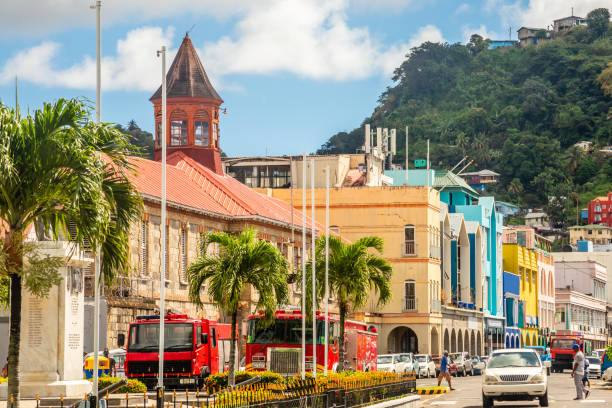
The following is an overview of the fintech ecosystem and its relation to wider economic development of Saint Vincent and the Grenadines in 2026.
Saint Vincent and the Grenadines knows what it means to rebuild. The eruption of La Soufrière in 2021 displaced thousands of people and damaged infrastructure across the main island. Three years later, Hurricane Beryl devastated communities across the Grenadines. These shocks arrived alongside the pandemic and the wider economic disruption experienced across the Caribbean.
For a country of around 100,000 people spread across 32 islands and cays, resilience is consequently not an abstract economic concept. It influences how roads are constructed, how businesses operate and increasingly how money moves.
This gives fintech a different purpose. Digital finance is not simply about replacing cash or producing start-ups. Reliable electronic payments, online government services and digital identification can help create an economy that continues functioning when physical infrastructure is disrupted.
In Saint Vincent and the Grenadines, fintech increasingly forms part of the resilience story.
Tourism has returned, but vulnerabilities remain
Tourism, construction, agriculture and services underpin the Vincentian economy, with Kingstown serving as the main commercial and financial centre. The Bank of Saint Vincent and the Grenadines is one of the country’s major financial institutions, alongside Republic Bank (EC) and other regional banks and credit unions.
The economy has recovered strongly from successive shocks, although momentum is slowing.
According to the International Monetary Fund (IMF), real gross domestic product (GDP) grew by 3.7 per cent last year and is projected to expand by 2.8 per cent this year. Tourism remains strong, but higher oil prices and weaker global conditions are weighing on the outlook. Public debt reached approximately 113 per cent of GDP in 2025, highlighting the fiscal cost of repeated reconstruction.
This environment makes digitalisation particularly relevant. A small economy cannot prevent hurricanes, volcanic eruptions or global economic shocks. It can, however, make government and financial services less dependent on physical locations.
A digital currency arrived after a volcano
One of the country’s most unusual fintech moments occurred shortly after La Soufrière erupted.
In July 2021, Saint Vincent and the Grenadines joined the DCash network developed by the Eastern Caribbean Central Bank (ECCB). DCash was a digital version of the Eastern Caribbean dollar and one of the world’s earliest retail central bank digital currency pilots. Consumers could use a smartphone wallet to transfer money, while businesses could accept digital payments without relying entirely on conventional cards or cash.
The ECCB specifically linked the introduction of DCash in Saint Vincent and the Grenadines with rebuilding following the volcanic eruption, demonstrating how digital payments could potentially support communities during periods of disruption.
The pilot was not without difficulties, including a regional outage in 2022. Nevertheless, DCash provided the Eastern Caribbean with valuable experience of what happens when a central bank moves beyond researching digital currency and actually places it in consumers’ hands.
For Saint Vincent and the Grenadines, it also demonstrated that being a small economy does not necessarily mean arriving late to financial innovation.
Fintech does not always look like a start-up

Saint Vincent and the Grenadines does not have a large domestic fintech ecosystem comparable with Jamaica or Trinidad and Tobago. Instead, much of its financial innovation comes through banks and companies operating regionally.
The Bank of Saint Vincent and the Grenadines, for example, provides mobile banking through its iBANK platform, enabling customers to check balances and transfer funds remotely.
Regional payment providers can also play an important role for Vincentian merchants seeking to accept electronic or online payments. This reflects the economics of operating in a country with a relatively small population.
A fintech company serving only Saint Vincent and the Grenadines faces an obvious ceiling on growth. Providers that operate across the Eastern Caribbean, however, can potentially serve consumers and businesses across several countries sharing the same currency and regulatory architecture.
The natural fintech market is therefore not one island. It is the Eastern Caribbean.
Government itself is becoming a digital customer
Perhaps the more significant transformation is happening outside banking.
Saint Vincent and the Grenadines is participating in the Caribbean Digital Transformation Project, financed by the World Bank and implemented alongside other members of the Organisation of Eastern Caribbean States.
Its ambitions extend well beyond putting existing government forms online. The programme includes an e-payment platform, electronic taxation, digital government infrastructure, cybersecurity, a citizen authentication system and digital unique identifier, alongside digital trade and property services.
These projects matter to fintech because digital government and digital finance reinforce one another. If citizens can prove their identity electronically, pay government fees online and interact with public agencies remotely, they have considerably more reason to participate in the digital economy.
Digital identity can also make financial onboarding easier by reducing dependence on physical documents and face-to-face verification.
Connectivity is part of financial inclusion
None of this works without reliable internet access. This past May, the National Telecommunications Regulatory Commission and FLOW signed an agreement for the Digital, Resilience, Inclusion, Virtual access and Empowerment (DRIVE) Project.
The five-year initiative is intended to improve connectivity for schools, vulnerable households and community organisations while strengthening emergency communications. Some qualifying households will receive subsidised internet costing EC$20 ($7.40 USD) per month, including a laptop and access to professional development.
This may appear separate from fintech; it is not. A digital wallet is of limited value to someone without affordable connectivity. Online banking cannot improve inclusion if customers cannot reliably access the internet. For small island economies, telecommunications policy and fintech policy increasingly overlap.
A new government inherits the digital transition
Saint Vincent and the Grenadines also entered a new political era after the New Democratic Party (NDP) won 14 of 15 parliamentary seats in November 2025, ending 24 years of government under Ralph Gonsalves and the Unity Labour Party. Godwin Friday became prime minister.
The new administration inherits both significant fiscal pressures and an increasingly ambitious digital transformation programme.
In February this year, the OECS Commission reaffirmed its support for Saint Vincent and the Grenadines’ digital agenda, highlighting improvements to public services, private-sector development and stronger integration with the regional and global economy.
The challenge will be ensuring that digitalisation remains a practical economic priority rather than simply another government strategy.
Looking ahead to the future
Saint Vincent and the Grenadines’ fintech opportunity is ultimately about making a geographically fragmented and disaster-exposed economy more resilient.
Digital payments, electronic government, better connectivity and regional financial infrastructure cannot prevent the next hurricane or volcanic eruption. They can reduce the number of essential services that stop functioning when one occurs.
For Saint Vincent and the Grenadines, that may be fintech’s most important contribution: not disruption, but ensuring the economy is easier to rebuild the next time resilience is tested.
The post Saint Vincent and the Grenadines: Building Digital Finance in 2026 appeared first on The Fintech Times.
