
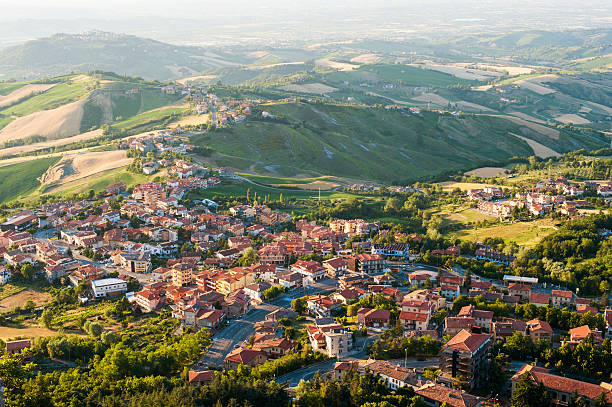
The following showcases the 2026 developments of fintech and wider digital landscape of San Marino.
For most countries, fintech is about making finance faster. For San Marino, it is about making the country more competitive.
Surrounded entirely by Italy and covering just 61 square kilometres, the world’s fifth-smallest state has spent much of the past decade redefining its economic identity. Long associated with banking, tourism and manufacturing, the republic has worked to modernise its financial sector following international pressure for greater transparency and stronger regulation.
Today, fintech has become part of that reinvention. San Marino is not trying to become Europe’s next fintech unicorn factory. It lacks the population, venture capital and domestic market for that ambition. Instead, it is focusing on creating a modern, digitally enabled financial system that supports businesses, attracts investment and integrates more closely with European financial markets while maintaining its own independent regulatory framework.
It is a quieter approach to fintech, but one that reflects the realities-and opportunities-of being one of Europe’s smallest economies.
A small economy with international ambitions
San Marino’s economy is remarkably diversified for a country of around 34,000 people. Manufacturing accounts for a significant share of exports, particularly machinery, ceramics, electronics, pharmaceuticals and specialised industrial products. Tourism remains a major employer, while financial services continue to play an important role alongside retail and professional services.
The capital, also called San Marino, serves as the country’s administrative and financial centre. Banking is dominated by institutions such as Cassa di Risparmio della Repubblica di San Marino (CARISP), Banca di San Marino and BAC Credomatic.
According to the International Monetary Fund (IMF), gross domestic product (GDP) per capita exceeds $60,000, placing San Marino among Europe’s wealthier economies despite its modest size. Its challenge is not generating wealth but ensuring that its financial system remains internationally competitive in an increasingly digital European economy.
Reinvention has become a necessity

San Marino’s financial sector has undergone profound change. Over the past two decades, international standards on tax transparency, anti-money laundering and financial supervision have transformed the operating environment for smaller financial centres.
Like several European microstates, San Marino has responded by strengthening regulation, improving international cooperation and repositioning itself as a transparent, well-regulated financial jurisdiction.
Digital transformation has become part of that broader strategy. Rather than competing on secrecy or tax advantages, policymakers increasingly recognise that future competitiveness will depend on efficiency, technology and regulatory credibility. Fintech therefore supports a much wider objective: rebuilding confidence in San Marino as a modern European financial centre.
Digital banking is replacing traditional banking
Unlike many emerging markets, fintech in San Marino is not primarily focused on financial inclusion. Bank account ownership is already widespread, while digital infrastructure is well developed.
Instead, innovation is centred on improving customer experience, reducing administrative costs and modernising financial services. Banks have expanded online banking, mobile applications, electronic payments and remote customer services as consumer expectations increasingly mirror those across neighbouring Italy and the wider European Union.
Digitalisation has also become important for businesses operating internationally, enabling faster payments, improved treasury management and more efficient cross-border financial operations. For many institutions, fintech is no longer viewed as a separate business line-it has become the future of banking itself.
Innovation is arriving through banks and specialised fintech firms
San Marino’s fintech ecosystem remains relatively modest, but several institutions are helping modernise financial services.
BKN301 Group, a Banking-as-a-Service (BaaS) and payments company headquartered in San Marino, has become one of the country’s best-known fintech success stories. Rather than serving only the domestic market, it provides embedded finance, digital payments, API banking and Banking-as-a-Service solutions across Europe, Africa and the Middle East. Its international footprint demonstrates how a fintech company can use San Marino as a base while operating globally.
Domestic banks have also accelerated digital investment. CARISP continues expanding digital banking capabilities, while Banca di San Marino has invested in online services and electronic banking for both retail and business customers.
Payment technology providers operating across Italy also increasingly serve businesses within San Marino, allowing merchants to adopt modern payment acceptance with relatively little friction despite the country’s unique jurisdictional status.
The result is an ecosystem where innovation comes less from hundreds of start-ups and more from a combination of internationally focused fintech firms and digitally transforming financial institutions.
Europe is shaping the future
Although San Marino is not a member of the European Union (EU), geography makes European regulation impossible to ignore.
Much of the country’s financial sector interacts closely with Italian and wider European markets. Developments such as open banking under PSD2, instant payments, digital identity and embedded finance are therefore influencing customer expectations within San Marino as well.
Negotiations on closer association with the European Union (EU) have also increased attention on regulatory alignment in financial services.
For fintech companies, harmonisation can reduce barriers to serving international customers while making San Marino a more attractive location for specialised financial businesses.
Technology is therefore becoming another way for the republic to deepen economic integration without sacrificing its political independence.
Regulation is becoming a competitive asset
The Central Bank of the Republic of San Marino (BCSM) has played an increasingly important role in modernising financial supervision. Alongside strengthening prudential regulation, the central bank has supported payment modernisation, financial stability and digital transformation while maintaining high supervisory standards.
For a jurisdiction whose international reputation is critical, regulation has become part of its competitive advantage rather than simply a compliance exercise. Investors, financial institutions and fintech companies increasingly value predictability, transparency and legal certainty as much as tax efficiency or operating costs; San Marino’s strategy reflects that shift.
Looking ahead
San Marino is unlikely to compete with London, Berlin or Milan as a European fintech hub. Instead, its opportunity lies in becoming a highly specialised financial jurisdiction where modern regulation, digital banking and internationally focused fintech companies coexist within a stable business environment.
For one of the world’s oldest republics, digital finance is not about disrupting the past. It is about ensuring that centuries of financial and commercial history remain relevant in an increasingly digital European economy. In San Marino, fintech is less a revolution than a carefully managed evolution-and that may prove to be exactly the right strategy.
