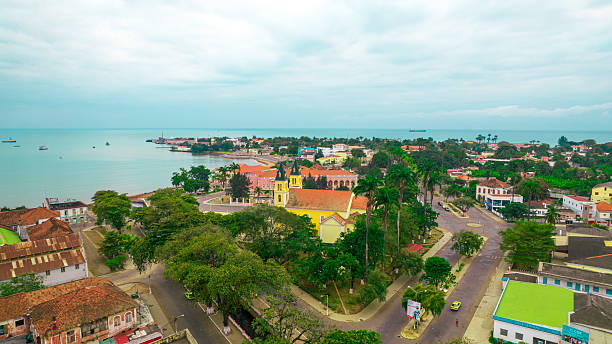
The following is an in-depth analysis of the fintech and wider digital economic development of African nation Sao Tome and Principe.
When people think about Africa’s digital economy, countries such as Nigeria, Kenya or South Africa usually dominate the conversation.
São Tomé and Príncipe rarely does. With a population of just over 230,000 people spread across two volcanic islands in the Gulf of Guinea, the former Portuguese colony is one of Africa’s smallest economies and countries. It is not home to a large fintech ecosystem, nor does it attract the level of venture capital seen elsewhere on the continent.
Yet small economies often face some of the biggest financial challenges. Limited banking infrastructure, high transaction costs, dependence on imports and the need to connect with international markets all make financial efficiency particularly important. For São Tomé and Príncipe, fintech is therefore less about building Africa’s next unicorn and more about creating practical solutions that improve everyday economic activity.
Digital finance, in this context, becomes an instrument of development.
São Tomé and Príncipe has a gross domestic product (GDP) per capita of around $2,700. The economy depends heavily on tourism, agriculture, fisheries, trade and public services, with cocoa remaining one of the country’s best-known exports. São Tomé, the capital, functions as the political, commercial and financial centre – all according to the World Bank.
Like many Small Island Developing States (SIDS), the country faces structural constraints that are difficult to overcome through scale alone. Its domestic market is limited, transportation costs are relatively high and much of its economic activity depends on external demand, development finance and international partnerships. These realities make efficient financial systems particularly valuable.
Payments, after all, are the foundation of commerce. Whether supporting tourism businesses, exporters, government services or household transactions, modern payment systems help reduce costs and improve economic participation. For countries with relatively small financial sectors, digital payments can often have an outsized impact. The Banco Central de São Tomé e Príncipe (Central Bank of São Tomé e Príncipe) has recognised this importance.

In recent years, the Central Bank has worked to strengthen payment systems, financial supervision and digital banking infrastructure while promoting broader financial sector modernisation. These efforts are increasingly aligned with wider goals around financial inclusion and digital transformation.
Financial inclusion remains an important priority. According to the World Bank’s Global Findex Database, many African countries have made substantial progress in expanding access to financial services over the past decade, particularly through mobile technologies. However, access continues to vary considerably between countries, with smaller island economies often facing additional infrastructure constraints.
For São Tomé and Príncipe, digital financial services offer opportunities to reduce geographic barriers while expanding access to banking and payments.
Although the country is geographically compact compared with many African nations, physical banking infrastructure remains limited. Mobile banking and digital financial services therefore have the potential to complement traditional banking rather than replace it.
The banking sector itself remains relatively small. Institutions including Banco Internacional de São Tomé e Príncipe (https://www.bistp.st/), Ecobank São Tomé and Príncipe and Energy Bank São Tomé provide much of the country’s formal banking infrastructure. Increasingly, these institutions are investing in digital channels that allow customers to conduct transactions without relying exclusively on physical branches.
The opportunity extends beyond consumers. Small and medium-sized enterprises (SMEs) form the backbone of São Tomé and Príncipe’s economy. Many operate in tourism, retail, agriculture and local services, where digital payments can simplify transactions, improve record-keeping and expand access to customers.
Tourism, in particular, presents an interesting opportunity. As international visitors increasingly expect cashless experiences, businesses benefit from payment systems capable of accepting international cards, digital wallets and online bookings. For a country seeking to grow higher-value tourism, digital payments become part of the visitor experience as much as the financial system itself.
Agriculture offers another area where fintech could contribute. Cocoa remains one of São Tomé and Príncipe’s most recognised exports. Digital financial services could help strengthen agricultural value chains by facilitating payments between farmers, cooperatives, exporters and buyers while improving financial access for rural producers.
Cross-border payments also deserve attention. As a small, import-dependent economy, São Tomé and Príncipe relies heavily on international financial connections. Businesses need efficient payment systems to import goods, while households benefit from affordable remittance services from family members living abroad.
Reducing the cost and complexity of international transfers could therefore have meaningful economic benefits.
The digital economy more broadly is also evolving. The World Bank and development partners have supported projects aimed at improving digital infrastructure, public administration and connectivity across São Tomé and Príncipe. As internet access improves, opportunities for e-commerce, online financial services and digital entrepreneurship are likely to expand.
While AI adoption remains at an early stage, financial institutions globally are increasingly using AI for fraud detection, customer support, compliance and operational efficiency. As São Tomé and Príncipe’s digital financial ecosystem matures, similar technologies could gradually become more relevant.
Challenges nevertheless remain significant. The domestic market is extremely small. Digital skills continue to develop, while attracting private investment can be difficult compared with larger African economies. Infrastructure, cybersecurity and consumer awareness will all require continued attention as digital financial services expand.
Regulatory capacity is equally important. Smaller jurisdictions must ensure that innovation is accompanied by effective supervision, consumer protection and financial integrity. Building trust in digital financial services is often just as important as introducing new technologies.
Yet the country’s size also creates opportunities. Policy reforms can often be implemented more quickly in smaller markets. Coordination between regulators, financial institutions and government agencies may be more straightforward than in much larger economies. This flexibility can become a competitive advantage if accompanied by strong governance.
Ultimately, São Tomé and Príncipe’s fintech future is unlikely to resemble that of Africa’s largest digital economies. Its ambition does not need to be producing billion-dollar fintech companies or becoming a continental financial hub.
Instead, success will be measured by something more practical: whether digital finance helps businesses operate more efficiently, improves financial access for households, supports tourism and agriculture, strengthens links with international markets and contributes to broader economic resilience.
For São Tomé and Príncipe, fintech is not about scale. It is about ensuring that even one of Africa’s smallest nations can participate fully in an increasingly digital global economy. In that sense, digital finance is not simply a technological upgrade – it is another step towards building a more connected, diversified and resilient island economy.
The post São Tomé and Príncipe: Fintech in Africa’s Second-Smallest Nation appeared first on The Fintech Times.