
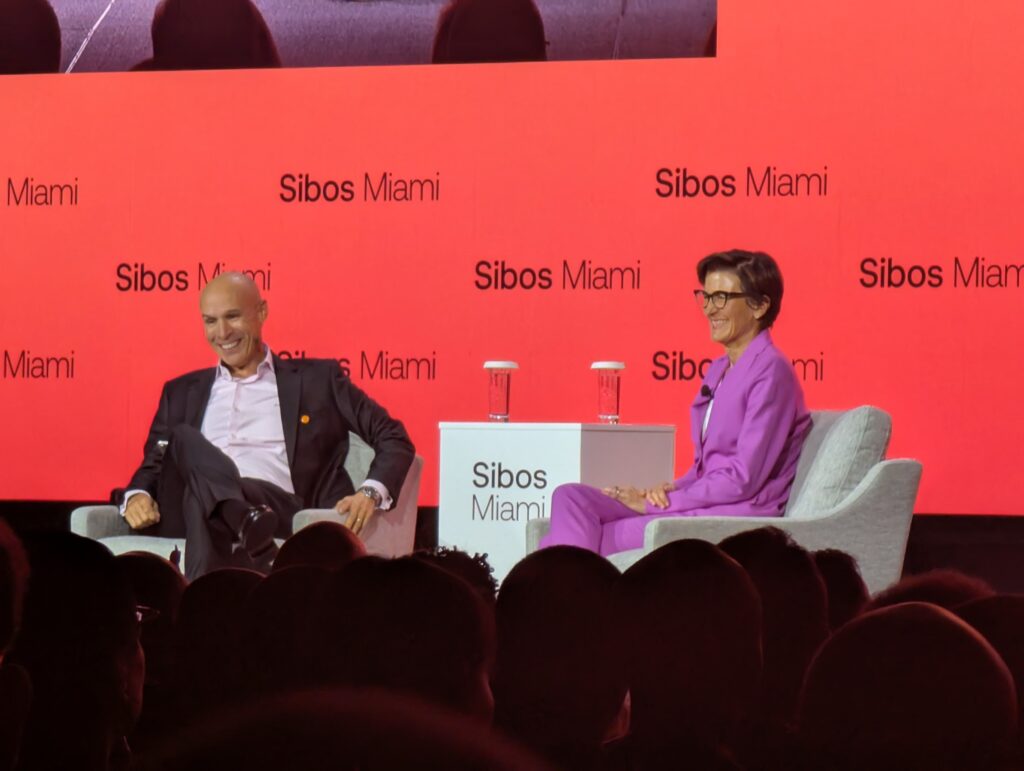
Sibos opened in Miami on Monday with Swift‘s Chair Graeme Munro telling a full Conference Stage 1 that this is the largest Sibos ever held in North America, and by the end of the opening plenary the week had its themes: put AI to work on the rails that already exist, make the new tokenised rails interoperable with them rather than a rival to them, and do both without spending the trust the system runs on.
Dan Katz, First Deputy Managing Director of the International Monetary Fund (IMF), gave the keynote and made the case that the biggest near-term gains from AI will come from improving the payment system we have now rather than reimagining it. Agents that continuously compare fees, rates and execution quality will lower switching costs and pressure incumbents, agents can automate the mechanics and timing of payments around liquidity and contractual obligations, and they could take much of the cost out of regulatory reporting and compliance. The benefits are largest in cross-border payments, where currencies, legal frameworks and regulation add friction, and at IMF staff’s estimate of close to a quadrillion dollars a year in cross-border flows, improvements measured in basis points are worth having. Tokenisation, he said, is the most promising route to the more programmable, interoperable system agents will need, which puts the burden on policymakers to let technologies compete on their merits, settle the legal nature of tokens and think about liquidity, since atomic settlement cuts counterparty risk but raises intraday funding needs. His warning was that competition is a financial stability question as much as an efficiency one, because overly narrow solutions produce institutions that fail in the same way, and that AI-driven cyber risk on shared infrastructure is the one to watch.
Javier Pérez-Tasso, Swift’s Chief Executive, answered the question he was asked in Frankfurt a year ago, which was whether Swift could deliver a ledger at all. It is live and in use by some of the largest institutions in the world, and by the end of the year at least 19 banks will be using it across five major currencies for 24/7 payments in tokenised deposits, with delivery-versus-payment and payment-versus-payment to follow. He was equally keen on the existing rails: half of all payments on Swift now reach the beneficiary bank in under 40 seconds, the consumer scheme launched last year is showing 37 seconds from Australia to India and 15 seconds from Turkey to the United States, and Swift’s own announcement of the day was a cross-border pay-by-alias initiative, a proof of concept with 14 institutions including BBVA, Bradesco, DBS, Commonwealth Bank of Australia and Citizens Bank, so a consumer can send money abroad to a mobile number or email address rather than an account number. Munro acknowledged that the original ISO 20022 timelines had caused difficulty and that Swift is adapting so the ecosystem is not disrupted, while the direction of travel has not changed.

Jane Fraser, Chair and Chief Executive of Citi, back at Sibos in person for the first time since the pandemic, tied the two together. Trade is not in retreat but rerouted, with Citi’s own trade flows up by double digits in the first half of the year and more than 70 per cent of client pain points now about releasing trapped liquidity, and resilience should not be treated as a cost, because a resilient institution can go on the offensive when bad things happen. She was blunt about an industry with a lot of hammers in search of a nail: clients want always-on, instant, safe and balance-sheet-efficient payments and do not want to think about the plumbing, which is why she likes tokenisation. Citi Token Services has just added the UAE and Japan to five existing centres, and Citi announced on Monday an expanded collaboration with Coinbase to connect stablecoin and fiat payments for corporate clients, which she described as the on and off ramp between the traditional rails and the digital world. For a bank spending USD 12 billion a year on technology, interoperability is the name of the game, and she reached for the railway gauge analogy to explain why common standards are what produce scale. “You can’t just have a new system and an old system that are competing against each other,” she said. “Our mandate has to move fast whilst retaining trust. If we break trust, that is a huge problem for the macro, for the markets, for everywhere.” On agentic commerce, the questions keeping the industry up at night are authentication and control: Citi’s answer is a control layer called Arc, through which every agent must be created, and she expects the old model of one manager supervising nine people to flip, with one agent watched by nine sets of eyes, most of them other agents.
The ledger’s supplier layer arrives
If no new bank went live on the ledger on Monday, the software vendors were busy making it easier to get there. Oracle announced an integration with Swift’s ledger so banks can bring tokenised deposits into interbank payment flows and run traditional and tokenised payments in one operating model. Cosmos said its tokenisation suite now provides connectivity for banks to participate in the ledger, and Taurus said from the floor that it has integrated the ledger into its custody and tokenisation platform. ACI Worldwide’s Craig Ramsey had made the argument for all of them on Sunday at Swift Partner Connect, that digital assets should extend a bank’s payment capabilities rather than force it to build a second payment operation. Circle and Volante made the same case for stablecoins, bringing USDC workflows into Volante’s payments-as-a-service platform so banks can evaluate stablecoin activity alongside the rails and controls they already run. Circle is also in Miami with Arc, its own blockchain that reached mainnet earlier this month with USDC as its settlement currency, which gives delegates three tokenised deposit tracks to weigh against each other: Swift’s ledger, IBM‘s ISO 20022 adapter for reaching it, and The Clearing House’s On-Chain Money initiative in the United States, for which it chose Quant last week to connect tokenised deposits at US banks to RTP and CHIPS from the first half of 2027. Fraser’s railway gauge point applies to all three. BNY, one of the ledger’s first-mover banks, showed on Monday that the existing rails still have room to run, enabling a pay-to-wallet capability that lets banks send cross-border payments from accounts to retail digital wallets using the Swift messages and correspondent infrastructure they already have, starting with Kookmin Bank in South Korea and Taishin Bank in Taiwan.
Temenos on the four kinds of tokenised money
On Stage, Temenos‘s Mick Fennell and Kaue Tozzi made the case that agentic commerce and programmable money are one project, not two. Tozzi argued that intent is becoming the new language of software, that the mandate standards emerging from the Google and Shopify camp and the OpenAI and Stripe camp will settle how an agent’s spending limits and permissions are expressed but not how they are surfaced to a customer, and that this is the bank’s job as the bearer of trust. His two no-regrets moves for any bank were to centralise data into a real-time, queryable knowledge graph and to retire batch processing in favour of real-time APIs. Fennell then sorted tokenised money into four types, central bank money, private stablecoins, bank-issued tokenised deposits and crypto, and cast them as the four musketeers: the principled CBDC, the bold but risky stablecoin, the disciplined tokenised deposit, and the flamboyant, dangerous crypto. A bank’s task is not to pick a hero but to assemble, govern and deploy the whole team, assessing each by source of trust, legal claim and whether a customer can exit at par under stress. Stablecoins settled around USD 33 trillion last year, more than the card networks, yet that is still under 1.5 per cent of global settlement, and the digital euro, with pilots next summer and a 2029 go-live, is the largest CBDC programme yet. Temenos also released its Banking Expectation Gap research with Celent at its stand on Monday; The Fintech Times has published a separate feature on it.
The Fintech Times on day one
The Fintech Times sat down with Bank of America and ACI Worldwide on Monday, and the same three themes ran through each conversation. The full interviews will be released later this week.
Fraser’s point that clients do not want to think about the plumbing was echoed almost word for word by AJ McCray, Managing Director and Head of Global Payments Product Management at Bank of America. The bank sees fiat real-time rails and tokenised deposits as complementary, picking the technology by use case, existing real-time networks for cross-border retail flows today and tokenised deposits as a strong candidate for sweeping money across a large corporate’s global treasury structure. “Our goal and our vision is that from a customer perspective, there is simply one solution,” he said. What that customer actually wants is to pay outside wire hours, to know the money arrived and to know the full value arrived: “It’s not just the instant payment itself, but really the instant confirmation of a payment.”
Tom Durkin, Global Head of CashPro at Bank of America, picked up the trust theme and the agents. Corporate treasurers do not want the status quo, he said, but they will not give up the controls they have built around existing rails, and any money moving on new rails will be expected to show up with the same visibility they get across CashPro today. He expects next year’s Sibos to be about agents doing business on clients’ behalf on the wholesale side, and had a prediction for the exhibition hall: “I think the word trust will probably be one of the most commonly used words across the exhibit hall the next four days.”
Phil Bruno, Chief Strategy and Growth Officer at ACI Worldwide, had come straight from the plenary and took Fraser’s interoperability point one step further: it only creates value when a bank can orchestrate across it, and the old model of a new division for every new payment type is over. On the stablecoin question hanging over the week, “if you have your own coin, you now need to think about interoperability, on-ramp and off-ramp, and how it is going to be transferable to other coins and to fiat. That adds complexity, it may add cost, and those trade-offs will be decided by the market.” The physics of payments still applies, so a few networks will be large and ubiquitous and the rest niche, and consumers will never notice which: “They want to check out.”
Around the floor
Ownera’s Monday breakfast brought Standard Chartered, DTCC, U.S. Bank, Bloomberg, Tradeweb, Fnality, HQLAx, Kaiko, Zodia Solutions and Taurus together on multi-chain repo and collateral with a Swift cash leg. KPMG’s Courtney Trimble ran a Spotlight session on the emerging economics of AI tokens, and Lloyds published a paper reviewing the UK’s National Payments Vision one year on. Day two brings Swift’s own “Live, Scaling, Next” ledger session at 09:30, a second Finastra launch, Bottomline’s payments research, and The Fintech Times on camera with HSBC, Proxymity and XDC Network.
The post Sibos 2026 day one: Fraser tells Miami to move fast without breaking trust appeared first on The Fintech Times.

