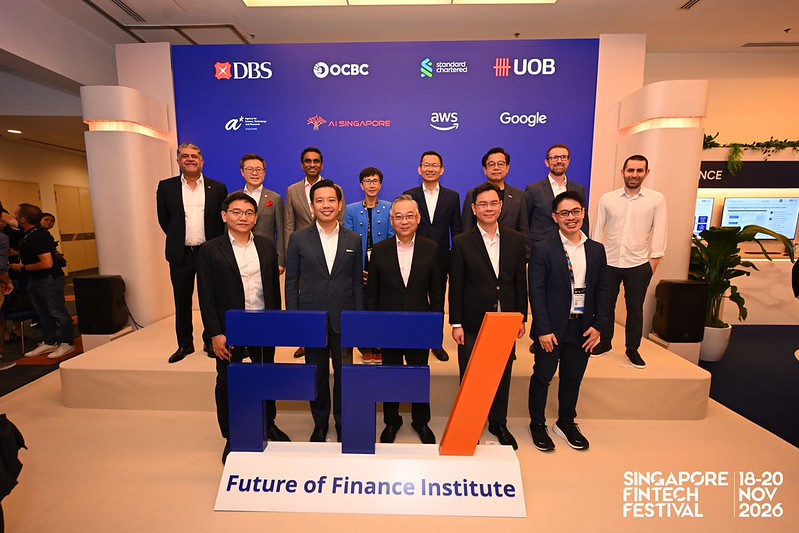
Day one of Singapore FinTech Festival and there’s already a lot to talk about. AI agents making payments on our behalf, banks experimenting with blockchain-based settlement, and new ways of getting finance to small businesses that have struggled to access traditional lending.
There are some exciting ideas being discussed.. but how will any of it actually work?
Organised by the Monetary Authority of Singapore (MAS) and the Global Finance and Technology Network (GFTN), the three-day festival is bringing together thousands of delegates from around the world to share their ideas about the future of financial services.
But how much of the conversation will actually be meaningful enough to cut through the usual corporate clichés around inclusion and safeguarding that usually permeate these conferences?
Fortunately, so far, quite a lot.
What’s particularly interesting is how the conversations around AI, digital money and financial inclusion are coming together. For years, we’ve heard about blockchain challenging the banks. Now we’re hearing about banks using blockchain themselves, while AI could soon be making decisions about how our money moves. And all this while millions of people and small businesses still struggle to access financial services.
Banks and blockchain are finding common ground
Yang Peng, CEO of Ant International, had plenty to say about where digital payments are heading. His company is working on a global payment network connecting digital wallets, with a particular interest in using blockchain-backed tokenised bank deposits, or what he calls ‘settlement tokens’, rather than conventional stablecoins.
But for Peng, the important thing isn’t necessarily the blockchain technology itself.
“The most important thing is not the ledger itself of blockchain, but the compliance and the asset [that] runs on this technology to prove it is a real settlement,” he explained.
By giving banks and financial institutions access to blockchain settlement, Peng believes the traditional financial sector can gain greater control over payments.
He also sees AI playing a big role, eventually working behind the scenes to find the fastest and cheapest way to move money. And he’s particularly keen for smaller businesses to benefit from better access to payments.
“This is what we all want to see,” he said.
There’s a lot to consider here, particularly as decentralised finance and traditional banking begin to find more common ground. The possibilities for faster, cheaper payments are exciting, but what happens when AI agents start making those decisions independently?
It’s something central bankers are already thinking about.
AI ambitions come with a few warnings
Professor Joachim Nagel, president of the Deutsche Bundesbank, was quite open about the uncertainty surrounding AI.
“Nobody knows what is next. AI is a disruptive technology, so every aspect of our lives is being – and will continue to be – influenced.”
He also highlighted the uncertainty caused by geopolitical conflicts, describing the difficulties facing the world economy.
“We are living in a very complicated world with so many new geopolitical conflicts. Fourteen years ago, things were much better. These are difficult times.”
Denmark’s central bank Governor Ulrik Nødgaard shares his enthusiasm for the potential of AI but warned that “circuit breakers around markets will be used more often” as autonomous systems become more powerful.
When AI agents can execute transactions at extraordinary speed, financial institutions will need to be one step ahead of what those systems are capable of doing.
Still, Nødgaard was confident about the industry’s ability to respond, reminding delegates that “our central bankers are innovators.”
And it’s not just central banks preparing for the changes ahead.
Singapore puts AI and human intelligence to work
Singapore is taking a particularly ambitious approach to AI. In a persuasive and thoughtful opening keynote, Deputy Prime Minister Gan Kim Yong highlighted the importance of combining AI with human intelligence to make financial services work for everyone. He also announced three national AI missions to help achieve that ambition.
The first tackles financial crime, encouraging banks to securely pool and share transaction data so AI can identify scams that might otherwise go unnoticed.
The second focuses on SME lending. Using AI to assess a wider range of information could help lenders identify businesses that might be overlooked because they lack a formal credit history.
The third looks ahead to agentic transactions, establishing safeguards and accountability for a future in which AI agents increasingly make payments on behalf of customers.

If there’s one place that stands a high chance of achieving these goals, it’s definitely Singapore. With a hands-on approach to AI education for its citizens, the country is already helping people develop the skills to make better use of the technology, including in financial services.
Singapore certainly seems determined to make these plans happen, and it’s good to see regulators taking such an active role in developing the technology.
Maha El Dimachki, managing director at GFTN, also questioned the old adage that “the US innovates, Europe regulates, and Asia imitates.”
We are all innovators, she suggests, but only time will tell whether innovation will be enough to create a more inclusive financial system.
But are people actually benefiting from digital finance?
For all the exciting developments in AI and digital money, there are still some very basic problems to solve.
Hari Menon, president of global growth and opportunity at the Gates Foundation, raised a good point about the way we measure financial inclusion.
“While global account ownership has reached 75%, it is premature to declare victory in the financial inclusion race when fewer than half of adults in emerging markets actually use those accounts to make payments or grow a business,” he said.
It’s easy to celebrate the number of people with bank accounts or digital wallets, but what happens once those accounts are opened?
Menon wants the industry to move away from counting digital wallets and focus instead on how people are actually using financial services. He talked about moving people from a digital highway into a “land of usage.”
And some basic problems still need solving.
Rwanda’s High Commissioner to Singapore, Innocent B. Muhizi, pointed out that despite 94 per cent mobile coverage in Rwanda, 20 per cent of phones are still basic devices, while many people don’t know how to use mobile apps.
Airtel Mobile Commerce chairman Ari Sarker also warned against simply introducing new technology without changing the processes behind existing services.
“The biggest mistake is adopting the latest technology without changing processes,” he said.
Menon offered a much more meaningful way to measure progress.
“Progress will be made when smallholder farmers know exactly what, when and where to plant their crops” and “when women see their incomes rise,” he said.
Given that small businesses are the backbone of every global economy and women make up half the world’s population and a significant part of the agricultural workforce, measuring outcomes through their quality of life seems like a pretty good place to start.
And one of the biggest ways to make a difference is helping entrepreneurs get access to finance.
Making better use of the data we’ve got
Small businesses have always faced challenges when trying to secure funding, particularly those without a formal credit history.
Alfonso Garcia Mora, vice president at the International Finance Corporation (IFC), explained just how difficult this can be in emerging markets.
“60% of SMEs in emerging markets do not use digital payments. So they are not visible. You don’t have data as a lender to assess if the micro enterprise is good or bad,” he explained during a conversation with CNBC Asia’s Manisha Tank.
But there is lots of information out there that could help.
Garcia Mora pointed to platforms such as Grab and Mercado Libre, which are using merchant data to assess businesses and provide loans at scale.
They have “hundreds of thousands of micro-entrepreneurs” using their platforms, and much more information about those businesses than “any traditional lender will ever have.”
And this brings us back to why AI, digital finance and traditional banking need to work together.
If fintechs can use alternative data to assess businesses, banks can provide funding and regulators can develop secure open finance frameworks, there is a real opportunity to make lending accessible to entrepreneurs who have struggled to get support.
But Garcia Mora believes the industry needs to stop approaching the problem from separate perspectives. Banks, fintechs, regulators, digital platforms and international institutions all have a part to play.
And the scale of the problem is enormous.
According to the World Bank Group, micro, small and medium-sized enterprises in developing countries face a $4trillion finance gap, despite accounting for 90 per cent of businesses and 75 per cent of employment in those economies.
It’s an extraordinary figure when you consider how much technology and data we already have at our disposal.
If we use the data out there, we can truly help close the lending gap. But digital technology and mobile connectivity alone will never solve the problem unless we also find ways to support the entrepreneurs who need it most.
“There is no way we can have an impact if we don’t put all these pieces together,” said Garcia Mora.
So what are we taking away from day one?
What I find encouraging about the conversations in Singapore so far is how many of these ideas are beginning to connect.
Banks are exploring blockchain-based settlement, AI could soon decide how payments move around the world, and new approaches to data could help businesses access finance that has traditionally been out of reach.
There’s certainly plenty of innovation to get excited about.
But the discussions about financial inclusion are an important reminder of what we’re trying to achieve. Millions of people have digital wallets they barely use, while businesses that could be creating jobs and supporting local economies still struggle to get funding.
We have the technology to move money around the world in seconds and are developing AI systems that can make financial decisions on our behalf. Surely we can also find better ways to help a small business get a loan?
Garcia Mora summed it up nicely when he said every entrepreneur should have the chance to try to realise their dream.
And if the technology being discussed in Singapore can help make that happen, it will be something worth celebrating. And that’s only day one. Two more to go.
The post Singapore FinTech Festival Gets to Grips with AI, Digital Money and Financial Inclusion appeared first on The Fintech Times.