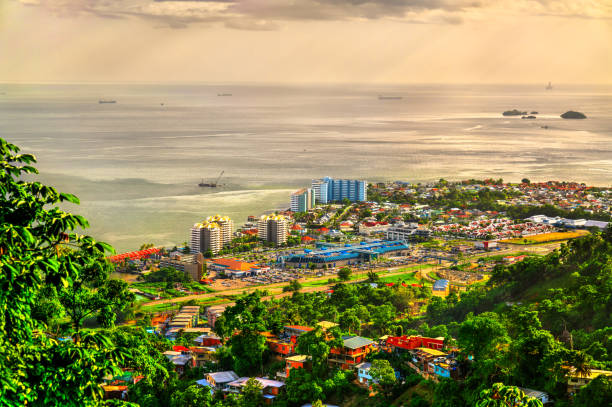
The following is an overview of the fintech ecosystem and its relation to wider economic development of Trinidad and Tobago in 2026.
Trinidad and Tobago is not an obvious candidate for a financial inclusion revolution. It has one of the Caribbean’s most developed banking systems, comparatively high incomes and a financial sector that extends well beyond its population of around 1.4 million people.
Port of Spain has long functioned as an important regional financial centre. Republic Financial Holdings, First Citizens, Scotiabank and RBC Royal Bank operate alongside credit unions, insurers and investment companies.
Yet cash remains remarkably persistent. Only 24 per cent of people surveyed in the country’s latest National Financial Inclusion Survey had a mobile application linked to their financial account. Three-quarters were formally financially included, but cash remained widely used for everyday transactions.
In 2026, Trinidad and Tobago is attempting to change that. The country is introducing an instant-payment platform modelled on India’s Unified Payments Interface (UPI), while electronic-money providers and home-grown fintech companies are gradually creating alternatives to traditional banking. For an economy built on oil and natural gas, the next piece of important infrastructure may be financial rather than energy-related.
Energy wealth created a different Caribbean economy
Trinidad and Tobago’s economy has little in common with the tourism-dependent model associated with much of the Caribbean. Oil, natural gas and petrochemicals transformed the country into one of the region’s wealthiest economies. Manufacturing, financial services, trade and professional services provide additional economic activity, while Tobago maintains a greater dependence on tourism.
Energy nevertheless remains both an advantage and vulnerability. The International Monetary Fund (IMF) expects real gross domestic product (GDP) to grow by around 0.8 per cent this year, following similar growth last year. The non-energy economy is expected to expand by 2.6 per cent, while energy output is forecast to contract by 4.5 per cent. Nominal GDP is projected to reach approximately TT$181.3billion, or around $26.7billion at the prevailing exchange rate.
New energy projects should eventually strengthen growth. But diversification remains important. Financial technology forms a small but increasingly visible part of that process.
The fintech problem is not opening bank accounts
Trinidad and Tobago’s financial inclusion challenge is more nuanced than in many developing economies.
The 2023 National Financial Inclusion Survey found that 75 per cent of people were formally financially included. Among them, 91 per cent had a commercial bank savings account. Debit cards are also widespread: 88 per cent of people with financial accounts had one linked to their account.
The digital picture looks different. Only 24 per cent had a mobile application linked to their financial account and 21 per cent had online banking through a website. Among people without a banking app, more than half said they did not know how to use one, while others cited lack of trust.
This means Trinidad and Tobago’s fintech opportunity is not simply bringing people into banking. It is getting people already inside the financial system to use it differently.
Then India entered the payments story

One of the most interesting developments is coming from thousands of miles away. Trinidad and Tobago is becoming the first Caribbean country to adopt a payment platform modelled on India’s UPI.
The government has partnered with NPCI International Payments Limited to develop infrastructure capable of supporting fast digital payments between individuals, merchants and government. The platform is intended to support government-to-person, peer-to-peer and peer-to-merchant transactions, while enabling 24/7 real-time settlement.
UPI transformed payments in India by making instant account-to-account transfers simple and inexpensive.Trinidad and Tobago obviously operates at a completely different scale. But that may actually make the experiment more interesting. If successful, it could provide a model for other Caribbean economies seeking alternatives to cash and conventional card networks.
Local fintech did not wait for UPI
Trinidad and Tobago already has its own financial technology companies. Perhaps the best-known is WiPay, which emerged as a Caribbean payments company providing electronic payment infrastructure to businesses and consumers.
Another example is PayWise, a Central Bank-registered electronic-money issuer. Its application enables consumers to send and receive payments, pay bills and fund their wallets using cards or cash through agents.
The market is becoming broader. The Central Bank reported that it had granted two additional electronic-money issuer licences during its 2025 financial year, while 11 payment service providers were under its supervision by September last year.
This demonstrates an important shift. Fintech is no longer operating entirely outside Trinidad and Tobago’s established financial architecture. It is becoming part of it.
The Central Bank is tightening the rules
That transition requires regulation. Electronic-money issuers and payment service providers operate under Central Bank oversight, with licensed providers able to facilitate transactions between individuals, merchants and government.
The supervisory framework is also becoming more sophisticated. The Central Bank has been implementing risk-based supervision for payment providers and electronic-money issuers, alongside broader reforms to the country’s payment infrastructure.
The objective is not simply encouraging more fintech companies. It is creating an environment where consumers trust them. That is particularly important when the national financial inclusion survey shows that knowledge and trust remain obstacles to digital adoption.
Foreign exchange adds another dimension
Trinidad and Tobago also faces a financial challenge rarely captured in discussions about fintech: access to foreign currency. The IMF continues to identify foreign-exchange shortages as an economic constraint, while international reserves have gradually declined.
This matters particularly for businesses. Companies importing goods, purchasing overseas software or paying international suppliers need access to foreign currency regardless of how sophisticated domestic digital payments become.
Fintech can make the domestic financial system faster. It cannot create US dollars. The country’s broader financial modernisation therefore needs to develop alongside reforms addressing these structural economic issues.
In conclusion
Trinidad and Tobago’s fintech story is entering an interesting stage. It already has established banks, high debit-card ownership and local payment companies. What it has not yet achieved is a decisive transition away from cash towards interoperable digital payments.
The UPI-style platform could change that. If consumers can move money instantly between people, businesses and government at low cost, the country’s digital-payment landscape could look considerably different within a few years.
Trinidad and Tobago spent decades building pipelines to move energy. Its fintech challenge in 2026 is rather different: building digital rails capable of moving money just as efficiently.
The post Trinidad and Tobago: Preparing for Payments Revolution appeared first on The Fintech Times.