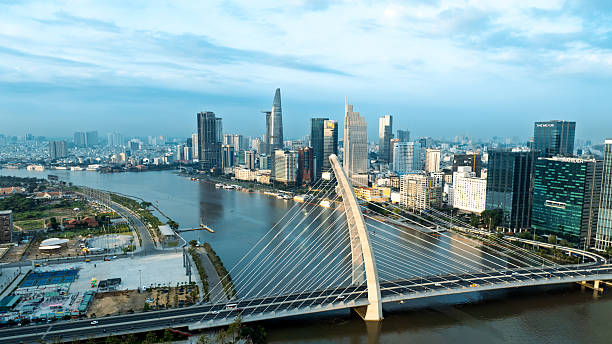
The following showcases the 2026 developments of fintech and wider digital of Vietnam.
For decades, Vietnam’s economic transformation could be seen inside its factories. Electronics, clothing, footwear, machinery and increasingly sophisticated manufactured products helped turn a country that was once among Asia’s poorest into one of the region’s most important production centres.
Now another transformation is visible on its streets. From coffee shops in Hanoi to small merchants in Ho Chi Minh City, scanning a QR code has become an ordinary way to pay. Mobile wallets compete with banking applications, cash is gradually losing ground and some of the country’s largest technology companies are increasingly connected with financial services.
In 2026, Vietnam wants to take that transformation further. The country has launched the Vietnam International Financial Centre, created a dedicated fintech hub in Ho Chi Minh City and is using regulatory sandboxes to experiment with new financial models.
Vietnam spent decades becoming one of the world’s factories. Its next ambition is to become one of Southeast Asia’s financial and technology centres.
Đổi Mới created the foundations
Vietnam’s fintech story ultimately begins long before smartphones.
The Đổi Mới reforms launched in 1986 gradually moved the country away from a centrally planned economic model and towards greater private enterprise, international trade and foreign investment.
The results have been extraordinary. Today, Vietnam is deeply integrated into global manufacturing supply chains. Electronics, machinery, textiles, agriculture, tourism and services underpin the economy, while Hanoi and Ho Chi Minh City are its principal financial and technology centres.
Major financial institutions include Vietcombank, BIDV, VietinBank and Agribank alongside a substantial joint-stock and foreign banking sector.
The International Monetary Fund (IMF) estimates Vietnam’s population at around 103.1 million in 2026, with nominal gross domestic product (GDP) per capita reaching approximately $5,120.
That combination of scale and rising incomes creates an attractive fintech market. A Vietnamese start-up does not need to expand internationally immediately to find millions of potential customers.
QR codes became almost invisible
Vietnam’s payments transformation has happened remarkably quickly. Back in early 2024, non-cash payment transactions were already increasing by more than 60 per cent year-on-year by volume. QR transactions were growing even faster, while tens of millions of bank accounts had been opened using electronic know-your-customer technology.
The most visible result has been the QR code. VietQR, developed around infrastructure from the National Payment Corporation of Vietnam (NAPAS), helped standardise QR transfers and payments across participating banks and payment providers.
For merchants, the attraction is obvious. A small food stall does not necessarily require an expensive card terminal. A printed QR code can be enough to receive a digital bank payment. This is particularly important in an economy containing enormous numbers of micro and small businesses. Vietnam’s payment transformation has consequently developed from the bottom up as much as the top down.
MoMo, VNPay and ZaloPay created a fintech generation

Vietnam also has one of Southeast Asia’s more established domestic fintech ecosystems.
First, MoMo is perhaps the country’s best-known fintech, evolving from an electronic wallet into a much broader financial and consumer-services platform.
Second, VNPay built extensive payment infrastructure around QR codes and merchant services, while ZaloPay benefits from its connection to the wider Vietnamese Zalo digital ecosystem.
Third, Finhay, meanwhile, helped introduce digitally delivered investment and wealth-management services to younger Vietnamese consumers.
These companies demonstrate how dramatically the market has changed. In 2015, Vietnam was estimated to have only around 39 fintech companies. By 2024, estimates had risen to at least 260, spanning payments, wealthtech, lending, blockchain and other financial services.
The challenge now is no longer proving that Vietnamese consumers will use fintech. It is determining which companies can build sustainable businesses around that adoption.
Regulation finally caught up
For several years, Vietnam’s fintech sector expanded faster than the regulatory architecture surrounding it; that began changing significantly last year.
The government introduced a formal fintech regulatory sandbox for the banking sector, providing a controlled environment for testing financial innovations under State Bank of Vietnam supervision.
This matters because fintech companies increasingly operate in areas where experimentation involves real financial risks. Payments, credit scoring and financial-data services can improve competition and inclusion, but they also create questions surrounding privacy, cybersecurity, consumer protection and financial stability.
Vietnam is therefore moving towards a model already familiar in Singapore and other major Asian fintech centres: allowing experimentation, but inside clearly defined regulatory boundaries.
Ho Chi Minh City wants something bigger
The most significant change in 2026 is considerably more ambitious. The Vietnam International Financial Centre in Ho Chi Minh City officially launched this past February as part of the country’s strategy to connect more directly with international capital. Then, in April, the centre officially launched its Fintech Hub. The hub is intended to provide shared digital financial infrastructure, strengthen cross-border capital connectivity and function as a sandbox for testing new financial models.
The wider financial centre has ambitions spanning cross-border payments, blockchain, artificial intelligence, digital assets, trade finance and next-generation financial products.
This changes Vietnam’s fintech proposition. The country is no longer simply trying to create successful domestic payment companies. It wants to attract international financial institutions and technology businesses too.
Ho Chi Minh City and Da Nang form an unusual model
Vietnam has also avoided concentrating its financial-centre ambitions in a single location. The International Financial Centre operates through a “one centre, two destinations” model covering Ho Chi Minh City and Da Nang.
Ho Chi Minh City provides the obvious financial base as the country’s largest commercial centre. Da Nang brings a different proposition, with ambitions around technology, digital assets, innovation and its strategic position in central Vietnam.
This past June, the government was calling for new financial products initially focused on trade, investment and fintech, while completing the centre’s operating and supervisory framework. This reflects a much broader ambition to move Vietnam higher up the economic value chain.
Looking ahead
Vietnam’s fintech transformation mirrors the country’s wider economic story. Đổi Mới opened the economy. Manufacturing connected it with the world. Smartphones and QR codes subsequently changed how millions of Vietnamese interact with money.
The next stage is more ambitious. Vietnam now wants fintech to help connect its economy with global capital through the new International Financial Centre, while domestic companies such as MoMo, VNPay and ZaloPay continue building financial products for more than 100 million potential consumers.
The country has already demonstrated that it can become an indispensable part of global manufacturing. Its challenge in 2026 is proving it can move from making the world’s products to helping build the financial infrastructure through which the region pays for them.
The post Vietnam: From the Factory Floor to a Fintech Future appeared first on The Fintech Times.