
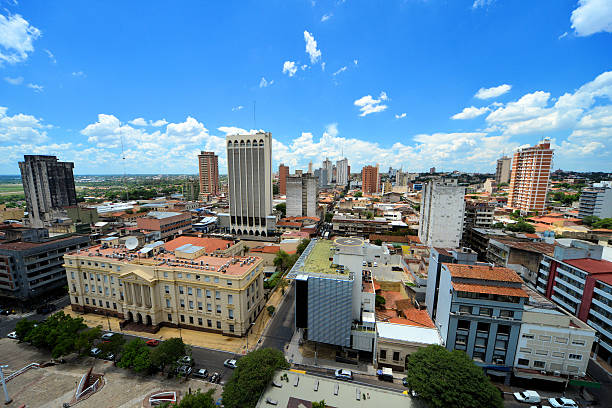
The following is an overview of the fintech ecosystem and its relation to wider economic development of Paraguay in 2026.
In many emerging markets, fintech begins by trying to replace banks. In Paraguay, it is doing something different.
The country’s financial technology sector is growing alongside a broader transformation of the economy itself. As more businesses move into the formal sector, digital payments are replacing cash, tax collection is becoming more efficient and small enterprises are gaining access to financial services that were previously out of reach.
This makes Paraguay an unusual fintech story. Rather than chasing the latest technological trend, its digital finance ecosystem is helping modernise one of South America’s fastest-growing economies.
The opportunity is significant. Paraguay has long been recognised for macroeconomic stability, abundant hydroelectric power and a business-friendly environment. Yet financial inclusion has lagged behind many of its regional neighbours, leaving considerable room for digital innovation.
Fintech is increasingly filling that gap – not by disrupting the financial system, but by gradually bringing more people and businesses into it.
A stable economy with untapped potential
Paraguay has built a reputation as one of South America’s most stable economies. Agriculture remains the backbone of exports, particularly soybeans, beef and cereals, while hydroelectric power generated by the Itaipú and Yacyretá dams provides inexpensive electricity that has supported industrial development.
Asunción serves as the country’s financial centre, with Banco Continental, Banco Basa, Sudameris Bank and Banco Familiar among the largest financial institutions.
Paraguay’s gross domestic product (GDP) per capita is projected to approach $7,400 this year, while the economy continues to outperform many regional peers thanks to prudent fiscal management and relatively low public debt.
Economic stability alone, however, does not automatically translate into financial inclusion. Much of Paraguay’s economy has historically remained cash-based, particularly among small businesses and rural communities; that is now beginning to change.
Cash is losing ground

For decades, cash dominated Paraguay’s retail economy. Small shops, market traders and family businesses often operated almost entirely outside the digital financial system. Limited access to banking services and low card acceptance reinforced this dependence on physical currency.
Digital payments are gradually altering that landscape. The Banco Central de Paraguay (The Central Bank of Paraguay) has prioritised modernising payment systems, improving interoperability and encouraging electronic transactions as part of the country’s wider financial inclusion agenda.
The objective extends beyond convenience. Electronic payments create transaction histories, making it easier for individuals and small and medium enterprises (SMEs) to access formal credit while also increasing transparency across the economy. In Paraguay, every digital payment potentially represents another step away from informality.
Financial inclusion remains the biggest opportunity
Unlike countries where fintech is primarily competing for affluent consumers, Paraguay’s largest opportunity lies in expanding access to financial services.
According to the World Bank, account ownership has increased significantly during the past decade, but large sections of the population remain underserved, particularly outside urban areas. Digital financial services therefore have considerable scope to expand access to payments, savings and credit.
The National Strategy for Financial Inclusion has placed particular emphasis on expanding digital payments, strengthening consumer protection and improving financial education. These priorities reflect a broader understanding that financial inclusion depends as much on trust and capability as it does on technology.
Home-grown fintechs are finding their place
Paraguay’s fintech ecosystem remains relatively small compared with Brazil or Mexico, but it is expanding steadily.
Bancard has become one of the country’s most influential payment companies, providing card processing, QR-code payments and payment infrastructure used by financial institutions and merchants across Paraguay. Its QR Simple platform has significantly expanded merchant acceptance of digital payments.
Another important player is Tigo Money, which leverages one of Paraguay’s largest mobile telecommunications networks to offer digital wallets, bill payments, domestic transfers and merchant payments. For many consumers, particularly those without traditional bank accounts, mobile financial services provide an accessible entry point into formal finance.
Digital banking has also accelerated through institutions including Ueno Bank, which has rapidly established itself as one of Paraguay’s most technology-focused financial institutions following its digital-first strategy and investment in mobile banking.
Other innovators, including Vaquita, Pago Express and various lending and payment providers, continue to broaden Paraguay’s fintech landscape as demand for digital financial services grows.
While the ecosystem is still modest by regional standards, its trajectory reflects increasing investor confidence and rising consumer adoption.
Regulation is encouraging innovation
One reason Paraguay’s fintech sector has developed steadily rather than explosively is the country’s regulatory approach.
Instead of pursuing rapid deregulation, policymakers have focused on strengthening payment infrastructure, improving financial-sector supervision and encouraging innovation within a stable regulatory environment.
The Central Bank has continued upgrading the country’s payment systems while supporting interoperability between financial institutions and electronic payment providers.
Meanwhile, the Paraguayan Fintech Chamber has become an increasingly important voice for the sector, bringing together payment companies, digital lenders, technology firms and financial institutions to support innovation and dialogue with regulators.
The result is an ecosystem built more on collaboration than confrontation.
Why small and medium enterprises (SMEs) matter
Perhaps the greatest beneficiaries of Paraguay’s fintech development are not consumers but small businesses.
SMEs account for the overwhelming majority of enterprises in Paraguay, yet many have historically struggled to obtain financing because they lacked formal financial records.
Digital payments are gradually changing that equation. Electronic transaction histories provide lenders with better information about business activity, reducing reliance on traditional collateral and enabling more data-driven lending decisions.
As payment acceptance expands, fintech could therefore become an important catalyst for SME growth rather than simply another payment option.
Looking ahead
Paraguay’s fintech sector is developing at its own pace.
Rather than trying to emulate Silicon Valley or compete with Latin America’s largest start-up ecosystems, it is addressing practical economic challenges: reducing reliance on cash, supporting small businesses, expanding financial inclusion and encouraging greater formalisation of the economy.
That may ultimately prove to be its greatest strength. The country’s fintech future will likely be measured less by billion-dollar valuations than by how many citizens gain access to formal financial services and how many businesses move from the informal economy into the digital one. In Paraguay, fintech is not simply transforming finance-it is quietly helping to reshape the wider economy.
The post Paraguay: Fintech Is Following the Formal Economy appeared first on The Fintech Times.
