
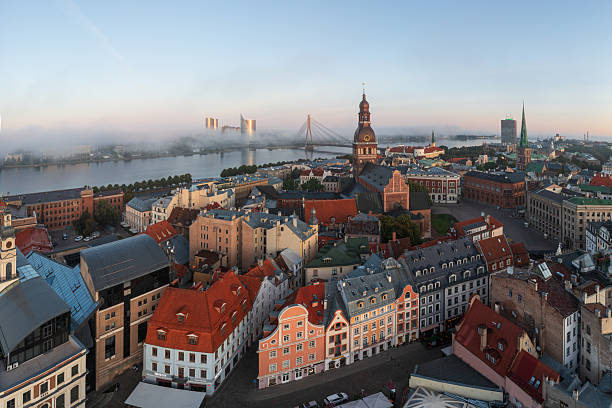
How is the Baltic nation of Latvia reinventing its financial identity? In particular with its linkages to wider economic development?
For much of the post-Soviet era, Latvia’s financial sector was known internationally for a very different reason than fintech. During the 1990s and early 2000s, the country developed a significant banking industry that served international clients, particularly from the Commonwealth of Independent States (CIS). However, following regulatory reforms, changing international standards and efforts to strengthen financial transparency, Latvia began reshaping its financial sector and redefining its role within Europe’s financial landscape.
Today, that reinvention is increasingly centred on technology. Rather than competing as an offshore banking destination, Latvia is positioning itself as a modern digital economy where fintech, innovation and financial infrastructure play a growing role in economic development. While neighbouring Estonia often attracts the headlines and Lithuania has emerged as a major fintech licensing hub, Latvia has quietly been building an ecosystem with its own distinct strengths.
The country’s strategy is less about becoming Europe’s next fintech unicorn factory and more about creating a competitive environment for financial innovation, digital services and cross-border business.
The broader economic context helps explain why. Latvia has undergone a remarkable transformation since joining the European Union (EU) in 2004 and adopting the euro in 2014. Today, the economy is supported by logistics, transport, information technology, financial services, manufacturing, forestry and professional services. According to the World Bank, gross domestic product (GDP) per capita now exceeds $26,000, while Riga serves as the country’s financial, commercial and technology centre.
As one of the Baltic states, Latvia benefits from close integration with both Nordic and European markets. This position has become increasingly valuable as digitalisation reshapes commerce, finance and cross-border business activity throughout the region.
Perhaps the most important factor influencing Latvia’s fintech future is not fintech itself, but digitalisation. According to the European Commission (EC)‘s Digital Economy and Society indicators, Latvia has made steady progress in digital public services, connectivity and business digitalisation. The government’s Digital Transformation Guidelines and Smart Specialisation Strategy increasingly place technology and innovation at the centre of economic policy.
Financial services are an important part of that agenda. The Bank of Latvia has emerged as one of the country’s most active proponents of financial innovation. In recent years, the central bank has increasingly positioned itself not only as a regulator but also as a facilitator of innovation.

A notable example is the Bank of Latvia’s Innovation Hub, which was created to support dialogue between regulators and financial technology firms. The initiative aims to help companies better understand regulatory requirements while encouraging responsible innovation.
This collaborative approach reflects a broader trend visible across Europe. Increasingly, regulators recognise that fostering innovation requires engagement with startups, technology firms and financial institutions rather than simply supervising them from a distance.
Latvia has also benefited from being part of the eurozone.
Membership of the single currency area provides access to European payment infrastructure and financial markets while reducing barriers for companies seeking to operate across borders. Participation in the Single Euro Payments Area (SEPA) and wider European financial systems creates opportunities for fintech firms focused on payments, remittances and digital financial services.
Payments have become one of the most dynamic areas of development.
Consumer behaviour has shifted significantly over recent years, with digital banking, mobile payments and contactless transactions becoming increasingly common. According to data from the Bank of Latvia, electronic payments continue to expand while cash usage gradually declines.
This evolution mirrors developments across much of Northern Europe and provides fertile ground for fintech innovation. Unlike some emerging markets where fintech addresses financial exclusion, Latvia’s ecosystem is focused more on efficiency, speed and user experience. Bank account penetration is already high, internet access is widespread and consumers are comfortable using digital services.
Consequently, fintech firms are increasingly competing on convenience and functionality rather than access. The country’s startup ecosystem has also matured.
According to Startup Latvia, the country hosts a growing number of technology startups operating across fintech, deeptech, artificial intelligence, mobility and software development. Riga has emerged as the centre of this activity, benefiting from a skilled workforce and competitive operating costs relative to many Western European cities.
Several Latvian fintech companies have attracted international attention. Among them is Jeff App, which uses alternative data and artificial intelligence to support lending decisions. Another example is Nordigen, which became one of Europe’s best-known open banking platforms before being acquired by GoCardless in 2022. The company’s success demonstrated that Latvian fintech firms could compete internationally in highly specialised areas of financial technology.
The Nordigen story is particularly significant because it highlights one of Latvia’s competitive advantages.
Rather than focusing exclusively on consumer-facing products, many Latvian fintech firms specialise in financial infrastructure, data services and business-to-business solutions. These segments often require strong technical expertise but less marketing expenditure than consumer-focused financial services.
Open banking continues to create additional opportunities. PSD2 transformed the European financial landscape by requiring banks to provide authorised third parties with access to customer account information. Latvia’s fintech sector has actively embraced these opportunities, particularly in areas such as account aggregation, payment initiation and financial data services.
The next wave of innovation may be driven by artificial intelligence (AI). Latvia’s broader digital development agenda increasingly emphasises AI adoption, while financial institutions explore opportunities to deploy machine learning across fraud prevention, compliance, customer service and risk management.
Artificial intelligence is also becoming important from a regulatory perspective. As financial systems become more complex and transaction volumes continue to rise, both fintech firms and regulators are seeking ways to improve efficiency through automation and advanced analytics.
Sustainability is another area receiving greater attention. As European financial markets increasingly integrate environmental, social and governance (ESG) considerations into investment and lending decisions, Latvian financial institutions are beginning to develop solutions that support sustainable finance, climate reporting and green investment.
Challenges remain. Latvia’s domestic market is relatively small, which means successful fintech firms often need to expand internationally at an early stage. Access to growth capital, while improving, remains more limited than in larger European ecosystems such as Berlin, London or Paris.
The country also faces ongoing competition from neighbouring Baltic markets. Estonia’s global reputation as a digital society and Lithuania’s success in attracting fintech licences mean Latvia must continue developing its own distinctive value proposition.
Yet this competition has also helped drive innovation across the region. The Baltic states increasingly function as a connected digital corridor where companies, investors and talent move across borders. Latvia benefits significantly from this regional integration.
Ultimately, Latvia’s fintech story is about transformation. The country has spent the past decade reshaping its financial sector, strengthening regulation and embracing digitalisation. In doing so, it has created the foundations for a new financial identity—one less reliant on its past role as a regional banking centre and increasingly focused on technology, innovation and modern financial services.
For Latvia, fintech is not simply another industry. It is becoming part of a broader effort to position the country within Europe’s digital economy and to demonstrate how smaller nations can compete through agility, expertise and innovation rather than scale alone.
The post Fintech and Wider Digital Ecosystem of the Baltics: Latvia in 2026 appeared first on The Fintech Times.


