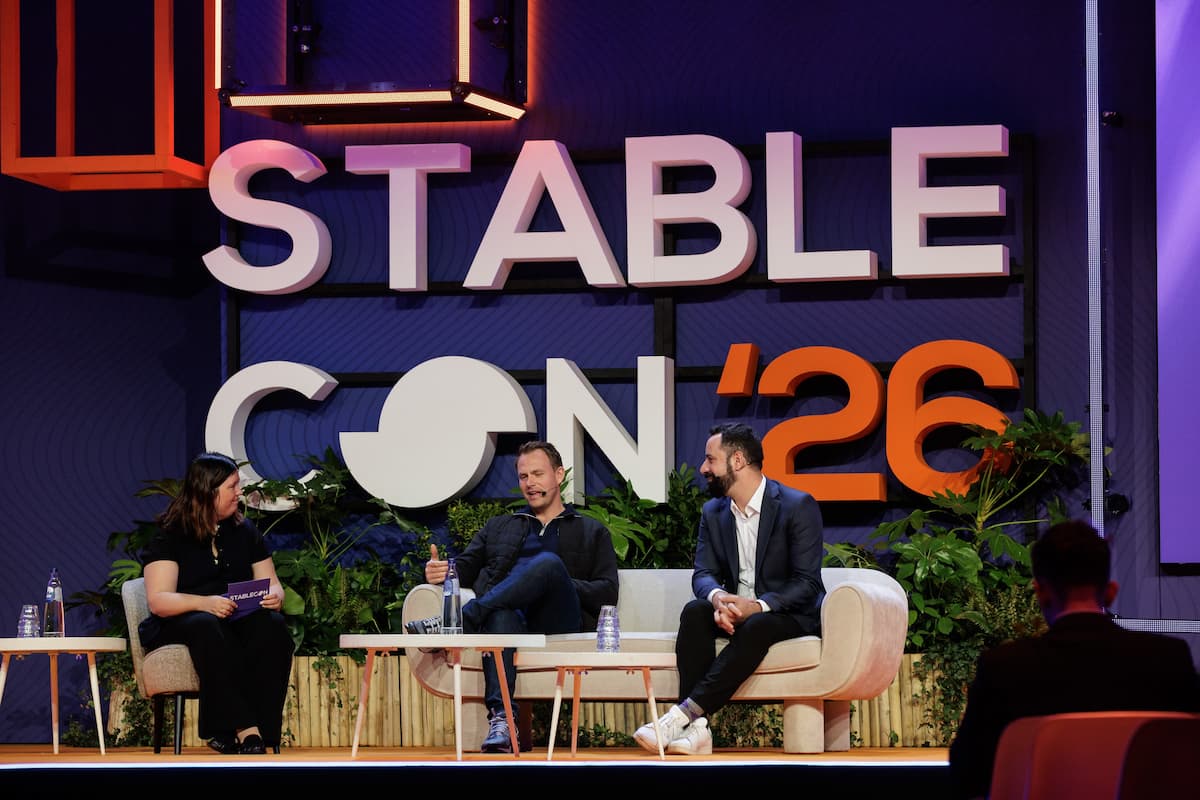
Stablecon Europe arrived in Amsterdam with a simple premise: bring together the people building the future of digital money before everyone else catches up. For the last two days, that’s exactly what it felt like.
Jeans and trainers replaced suits and ties. A DJ welcomed attendees through the doors. Wood, plants and cubes in vibrant colours gave the venue more of a WebSummit feel than a traditional finance conference. It felt busy, curious and surprisingly relaxed for a sector discussing the future of money. More importantly, it felt early.
Because while stablecoins are now firmly part of mainstream financial conversation, many people are still trying to work out exactly where this market is heading, and who will still be standing when it gets there.
Some attendees came to sell. Others came to listen. In a market this new, there is still enormous value in simply getting experienced people in the same room. Underneath the branding, networking and boat parties, there was a serious conversation taking place around infrastructure.
Not just launching tokenised products, but rebuilding parts of the rails underneath payments, settlement and compliance itself. It felt exciting: Faster settlement. Lower friction. Cheaper cross-border payments. And real improvements for remittances. But it also creates new problems.
As AI agents, programmable payments and embedded finance continue to evolve, the industry is increasingly wrestling with questions around fraud, AML controls and compliance exposure. Many established firms are still rowing firmly in the B2B lane for exactly that reason.
Still, one message came through consistently across the event: the next two years could fundamentally reshape payments infrastructure. The bigger question is who survives long enough to benefit from it. That tension between innovation and control was particularly clear in conversations around compliance infrastructure.
Speaking to The Fintech Times, Richard Beverley, CEO of startup Block Infrastructure, described a future where compliance checking becomes almost entirely automated. “The aim is to become binary,” he explained, pointing to the manual interventions that still sit behind roughly two per cent of transactions today.
For Beverley, that remaining margin of human processing is where cost and risk still exist. AI models trained on onboarding data, ownership structures and transaction behaviour could eventually remove much of that manual review process altogether.
“Atomic compliance equals atomic settlement,” he said, admitting that It is not the most glamorous part of the stablecoin market. But several conversations at Stablecon pointed towards the same conclusion: the real winners may not be the loudest brands, but the infrastructure companies quietly solving trust, verification and interoperability in the background.
That conversation also carries geopolitical weight. USDC and USDT continue to dominate liquidity, reinforcing the role of the dollar far beyond traditional banking rails. Multiple speakers raised questions around sovereignty, local currency stablecoins and whether entire regions risk becoming dependent on digital dollars.
“The stablecoin space is dominated by the dollar but we need local currency stablecoins in Africa to break down barriers and protect sovereignty,” said Mimi Kufuor, COO at KoinKoin.
Others warned the market may not wait for perfect regulation or domestic alternatives to emerge. “If you don’t have a credible liquid on-chain asset today, you risk being left behind whilst you build a perfect solution tomorrow,” said Kene Ezeji-Okoye, CBO at Ubyx Inc.
That urgency is particularly visible in emerging markets. Discussions focused heavily on Africa, Latin America and cross-border corridors where payment friction, currency instability and banking access issues are already creating practical demand for stablecoin infrastructure.
Speaking during a panel moderated by Gina Clarke of The Fintech Times, Gideon Greaves, MD at SuperCoin, discussed the challenge of balancing innovation with regulation across African markets.

“When innovation comes to market, everyone is always scared of change,” he said. Also highlighting that launching your own coin is “Bloody expensive, the invoices just keep on coming”. Still, with regulation shifting quickly in South Africa and beyond, owning your own rails could be the risk that pays off.
At the same time, traditional finance is no longer watching from the sidelines. Execs from companies including Mastercard, Visa and Deutsche Bank focused less on speculative crypto narratives and more on user experience, interoperability and invisible payments.
“Everybody wants to shop online, split a meal, subscribe to Netflix or Spotify, but nobody wants to pay,” said Christian Rau, SVP Digital Assets and Blockchain at Mastercard. The future, many suggested, is payments that disappear into the background completely.
Stablecon Europe still felt slightly like a pre-party for what comes next. Much of the industry is now waiting for the US regulatory environment to accelerate the market further, particularly with legislation including the GENIUS Act now here and CLARITY continuing to move through the political process.
That is also why Stablecon’s next event in Washington in September already feels significant. Amsterdam may not be where the biggest benefits of stablecoin adoption are ultimately felt. Those are more likely to emerge across the US, Africa and Latin America.
But as a place to compare notes, test ideas and quietly work out where the market is heading next, it worked. And if you were still wondering whether stablecoins are becoming part of mainstream financial infrastructure, Stablecon gave a fairly clear answer.
They already are.
The post Stablecon Europe: Building for an Industry Still Taking Shape appeared first on The Fintech Times.