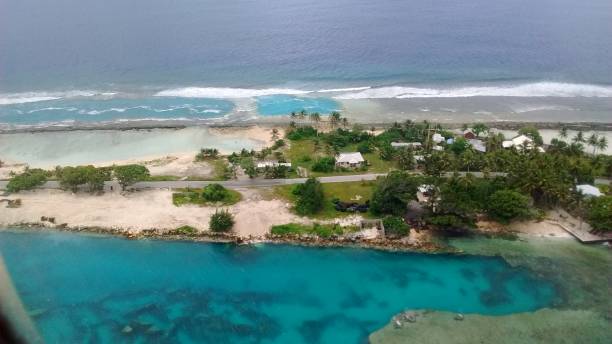
The following looks at the fintech, digital and wider economic development of small Pacific Island nation of the Marshall Islands.
The Republic of the Marshall Islands is often discussed through the lens of geography, climate vulnerability or its strategic location in the Pacific. Yet there is another challenge that receives far less attention: financial connectivity.
For many countries, access to financial services is largely taken for granted. Businesses can open bank accounts, consumers can transfer money digitally and payments move seamlessly through domestic and international financial networks. For small island developing states such as the Marshall Islands, however, maintaining these connections has become an increasingly important economic issue.
This is where fintech enters the conversation. Unlike major fintech markets where innovation is focused on artificial intelligence, embedded finance or digital wealth management, the fintech opportunity in the Marshall Islands is far more fundamental. It centres on financial access, payment connectivity, remittances and ensuring that individuals and businesses remain connected to the global financial system.
In many respects, the country’s fintech journey is less about disruption and more about economic resilience. The Marshall Islands is one of the world’s smallest sovereign economies. According to the World Bank, gross domestic product (GDP) per capita is approximately $6,000, while the economy relies heavily on public administration, fisheries, transportation, development assistance and economic support linked to the Compact of Free Association with the United States.
The nation’s population of around 42,000 people is spread across dozens of islands and atolls covering a vast area of the Pacific Ocean. Majuro serves as the country’s capital and principal economic centre, while Ebeye remains another important population hub.
These geographic realities create unique financial challenges. Small populations, dispersed communities and significant distances between islands make traditional banking infrastructure expensive to maintain. The economics that support large banking networks elsewhere often do not apply in small Pacific island states.
As a result, digital solutions increasingly offer one of the most practical ways to improve financial access.

The importance of this issue has grown over the past decade due to concerns around correspondent banking relationships. Several Pacific island nations have faced challenges maintaining access to international banking networks as global banks reassessed risk and compliance costs.
The International Monetary Fund (IMF) and the World Bank have repeatedly highlighted the importance of preserving financial connectivity for small island economies, noting that disruptions can affect remittances, trade and broader economic activity.
For the Marshall Islands, fintech solutions may help address some of these vulnerabilities by improving payment efficiency and reducing dependence on costly traditional financial channels.
The country’s financial services sector remains relatively small. Banking services are primarily provided by institutions such as the Bank of Marshall Islands and the Marshall Islands Development Bank. While these institutions play an important role in supporting the economy, expanding physical banking infrastructure across remote islands remains challenging.
This reality has encouraged growing interest in digital financial services. Across the Pacific, mobile banking and digital payments are increasingly viewed as tools that can help overcome geographic barriers. Digital financial services could improve access for populations living far from traditional banking infrastructure.
The Marshall Islands exemplifies this challenge. For many households and businesses, digital solutions have the potential to reduce travel costs, improve access to financial services and facilitate participation in the formal economy.
Connectivity is therefore becoming a critical enabler. The Asian Development Bank (ADB) has supported telecommunications and digital infrastructure projects designed to improve internet access and strengthen digital capabilities. As broadband coverage expands and digital adoption increases, opportunities for fintech development are likely to grow alongside it.
The government has also recognised the importance of digital transformation within broader economic development strategies.
Although the Marshall Islands does not yet possess a large domestic fintech ecosystem, policymakers increasingly understand that digital infrastructure underpins future economic competitiveness. This includes financial services, government administration, education and commerce.
One area where the Marshall Islands attracted significant international attention was digital currency. In 2018, the country announced plans to explore a national digital currency known as the Sovereign (SOV), positioning itself as one of the first countries to publicly consider a blockchain-based national currency initiative.
The proposal generated global debate. Supporters argued that digital currencies could improve financial inclusion, reduce transaction costs and create new economic opportunities. Critics, including the IMF, raised concerns regarding financial stability, anti-money laundering compliance and reputational risks.
While the initiative has evolved over time and has not yet transformed the country’s financial system, it nevertheless demonstrated the willingness of policymakers to explore unconventional approaches to financial innovation.
Few countries of comparable size have attracted such international attention in discussions surrounding digital currencies.
Beyond digital assets, remittances remain one of the most important opportunities for fintech. Many Marshallese citizens live and work abroad, particularly in the United States under provisions of the Compact of Free Association. Money sent home by overseas workers plays an important role in supporting families and local communities.
Reducing remittance costs has therefore become a key objective across many Pacific economies. Globally, fintech firms have transformed cross-border payments through digital transfer platforms and mobile-based solutions. Similar innovations could help increase the efficiency and affordability of remittance services for Marshallese households.
Climate resilience also shapes the country’s digital future. The Marshall Islands is among the countries most exposed to rising sea levels and climate-related risks. According to the United Nations (UN), low-lying atoll nations face significant environmental challenges that could affect infrastructure, livelihoods and long-term development.
Digital finance may not solve climate change, but it can support resilience. Around the world, fintech tools are increasingly used to distribute emergency assistance, facilitate insurance products and improve the delivery of climate-related financing. For vulnerable island economies, these capabilities could become increasingly valuable.
Nevertheless, significant obstacles remain. The domestic market is extremely small. Telecommunications costs remain relatively high compared to larger economies. Digital literacy varies across communities and attracting private-sector fintech investment can be difficult.
Regulatory capacity is another consideration. As digital financial services expand, policymakers will need to balance innovation with consumer protection, cybersecurity and financial integrity.
Yet despite these challenges, the broader direction of travel is clear. Across the Pacific, financial services are becoming increasingly digital. Improvements in connectivity, mobile technology and payment infrastructure are gradually changing how individuals interact with financial systems.
The Marshall Islands is likely to be part of that transition. Its fintech future may not resemble the ecosystems developing in Europe, Asia or North America. Instead, it will likely focus on practical solutions that address local realities: improving access, strengthening financial connectivity and supporting economic resilience.
Ultimately, fintech in the Marshall Islands is not about becoming a global innovation hub.
It is about ensuring that one of the world’s most remote nations remains connected – to financial services, to economic opportunities and to the wider global economy. In that sense, digital finance could become an increasingly important tool not only for economic development, but also for ensuring that geography no longer determines financial opportunity.
The post The Marshall Islands and its Fintech and Digital Ecosystem appeared first on The Fintech Times.