
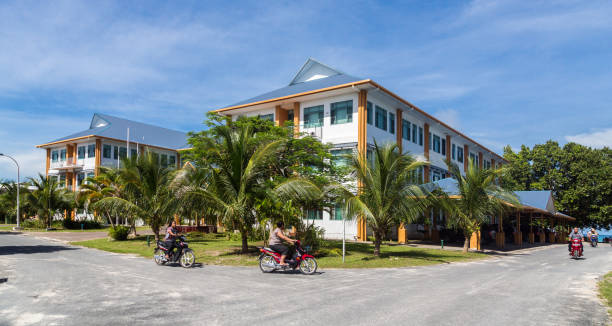
The following is a fintech and wider digital economic development view of the US Pacific territory of Tuvalu.
In Tuvalu, financial technology starts with geography. The Pacific island nation has a population of only around 11,000 people scattered across nine islands and atolls. Its capital, Funafuti, is more than 1,000 kilometres from Fiji and thousands of kilometres from the major financial centres of Australia and Asia.
There is only one domestic commercial bank. Until recently, even ATMs were absent. And reliable international internet connectivity has historically been considerably more difficult and expensive than in most larger economies. This makes talking about Tuvaluan fintech companies almost beside the point.
In 2026, Tuvalu is still constructing the foundations upon which a digital financial system could eventually develop. Its first international submarine cable has arrived, Starlink is available, mobile money has been under development and the country has introduced its first ATMs and point-of-sale machines.
For Tuvalu, fintech is not about disrupting banks. It is about overcoming distance.
One of the world’s smallest economies operates differently
Tuvalu is tiny even by Pacific standards. The economy relies heavily on the public sector, fishing-licence revenues, development assistance, remittances and income from the .tv internet domain, which happens to have considerable international commercial value because of its association with television and video.
The International Monetary Fund (IMF) projects real gross domestic product (GDP) growth of around 2.5 to 2.6 per cent this year, following approximately three per cent growth last year. Infrastructure projects and government spending remain important economic drivers.
The government’s finances demonstrate just how unusual the economy is. IMF projections suggest fishing-licence fees could generate approximately A$38.3million in 2026 (over $28million), while licensing of the .tv domain could contribute another A$11.2million (shy of $8million). To note, the country uses the Australian dollar as one of its main currencies alongside the Tuvaluan dollar which is pegged to the Australian dollar.
There is effectively one commercial bank
The financial system reflects that small scale. The IMF identifies two state-owned banks -the National Bank of Tuvalu (NBT) and Development Bank of Tuvalu – alongside the Tuvalu National Provident Fund. The National Bank of Tuvalu is the country’s only commercial bank, with foreign-exchange transactions representing an important source of income.
That creates a very different competitive environment from neighbouring markets such as Fiji. There are no dozens of commercial banks fighting for digital customers and no large domestic venture-capital ecosystem funding fintech start-ups.
Financial modernisation therefore depends heavily on established institutions, government policy and international development partners. But modernisation is happening.
The ATM is itself part of the fintech story
In London or Singapore, mentioning an ATM in an article about fintech would sound almost absurd. In Tuvalu, it represents genuine financial modernisation.
The government’s 2025-2026 National Budget highlights the introduction of the country’s first ATMs and point-of-sale machines, describing them as an important improvement in financial access and convenience.
This illustrates why fintech needs to be understood differently depending on the country. A sophisticated economy might be discussing tokenised deposits and artificial-intelligence-powered investment products.
Tuvalu is beginning with the ability to withdraw money electronically and accept card payments more easily. Neither transformation is insignificant to the people using it.
Mobile money could matter much more

The next step is potentially more transformative. Tuvalu’s National Broadband Plan identifies mobile money as nearing completion, alongside wider telecommunications and digital-infrastructure improvements.
A functioning mobile-money service could be particularly valuable in the outer islands. Building and maintaining conventional banking infrastructure across a population scattered over remote islands is expensive.
Mobile financial services offer another model. Someone should not necessarily need a physical bank branch nearby to transfer money, receive funds or eventually pay for goods electronically. But mobile money requires something else first. It requires connectivity.
Then the internet changed
This is arguably the most important part of Tuvalu’s emerging fintech story. The country’s first international submarine telecommunications cable, the Tuvalu Vaka Cable, landed in late 2024, with service development continuing thereafter. At the same time, Starlink became available in Tuvalu in January 2025.
Tuvalu Telecommunications Corporation subsequently began offering locally managed Starlink Priority Plans, including billing in Australian dollars and local payment arrangements. The government has also been rolling out fibre-to-the-premises infrastructure in Funafuti.
These developments could matter more to fintech than any individual financial application. A digital wallet cannot transform financial inclusion if users cannot reliably connect to it. Better internet changes what becomes possible.
Financial isolation is the bigger regional threat
Tuvalu nevertheless faces another problem that no domestic fintech application can solve. Correspondent banking.
Small Pacific island economies process relatively low transaction volumes, making them commercially less attractive to large international banks. The withdrawal of correspondent banking relationships can make it harder and more expensive to send money internationally, conduct trade or receive remittances.
The World Bank describes the loss of these relationships as one of the Pacific’s most urgent financial challenges. Tuvalu is consequently participating alongside Fiji, Kiribati, the Marshall Islands, Samoa, Solomon Islands, Tonga and Vanuatu in a regional programme designed to preserve access to international banking.
Each participating country committed $9million of International Development Association resources to the initiative.
One proposal under consideration is a Pacific Payments Mechanism. Rather than every tiny Pacific financial institution maintaining international connections independently, the proposed system would use a shared platform connecting banks and non-bank providers under common standards and services. A feasibility study was expected to inform the next stage of the initiative during 2026. For Tuvalu, this could ultimately be more important than producing its own fintech start-up.
Remittances make connectivity financial
International payments matter particularly because Tuvaluans increasingly participate in overseas labour-mobility programmes. Workers earning money abroad can support families at home through remittances.
Yet every additional fee imposed on a transfer reduces the amount ultimately reaching the recipient. Digital remittance infrastructure and stronger regional payment connections could therefore have an outsized impact on a country this small.
The same applies to local digital payments. A shop accepting an electronic payment creates a transaction record. Over time, digital transaction histories can potentially make it easier for small businesses to demonstrate revenues and access formal finance. For Tuvalu, the progression is therefore gradual: connectivity enables payments; payments create data; and data can eventually support broader financial services.
Climate change gives digitalisation another meaning
There is also no separating Tuvalu’s development from climate change. The country’s extremely low-lying geography makes it particularly vulnerable to sea-level rise, coastal erosion, storms and flooding. Tuvalu has consequently become internationally known for its efforts to preserve elements of the country digitally while investing heavily in physical climate adaptation.
Financial resilience forms part of that challenge too. A banking and payment system serving dispersed islands must continue functioning when physical infrastructure is disrupted.
The same redundancy being created through submarine cable, satellite and fibre connectivity could therefore become important for financial resilience. In Tuvalu, digitalisation is not simply about convenience. It is increasingly connected with national resilience.
Looking ahead
Tuvalu will not become the Pacific’s next fintech hub. That is the wrong measure of success. The more relevant question is whether a person living on one of the world’s most isolated island nations can access financial services almost as easily as someone living somewhere much larger.
For the first time, the pieces are beginning to come together. ATMs and point-of-sale machines have arrived. Mobile money has been under development. Starlink and the country’s first international submarine cable are transforming connectivity, while regional cooperation could help protect Tuvalu’s connection with the global banking system.
In most countries, fintech begins with an entrepreneur building an application. In Tuvalu, it begins with something more fundamental: making sure the connection reaches the island in the first place.
The post Tuvalu: Fintech Begins With Getting Connected appeared first on The Fintech Times.

